Watch for fraudulent messages that appear to come from the City of Raleigh
Published 3/23/2026 at 1 p.m.Updated 3/24/2026 at 3 p.m.
Thank you for printing this page from the City of Raleigh's Official Website (www.raleighnc.gov)
https://raleighnc.gov/projects/tarboro-street-corridor-project
03/09/2026 3:46 pm
Transportation
Tarboro Street Corridor Project
Build a stronger foundation. Build a stronger community.
Updated: Mar 9, 2026
The City is considering updating N Tarboro Road between Oakwood Avenue and New Bern Avenue. This initiative was identified through station area planning associated with the Wake BRT: New Bern Ave project.
The Reason Why:
We want to invest in infrastructure for current and future residents that will provide a safe and reliable connection along the street for pedestrians, cyclists, and vehicles.
Some of the things we are thinking about with this project include:
The lack of safe pedestrian connectivity between BRT station and places of employment and residences;
Creating art and streetscape elements along the corridor; and,
Making the street safe for walking, bicycling, or driving.
Informed by community outreach, the final design includes placemaking elements, pedestrian improvements, and traffic calming elements that promote safety for pedestrians and cyclists.
Utilities and Lighting
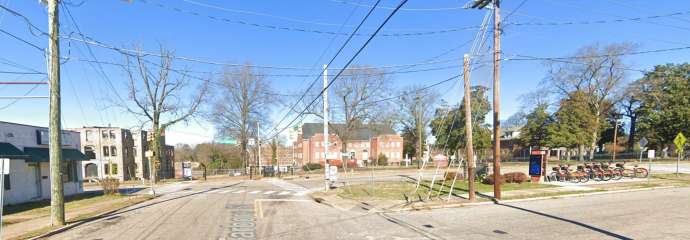
To reduce overhead utilities, The City is coordinating with private utilities to consolidate utility lines and remove excess utility poles. During this process, a lighting analysis of the corridor will be performed, and additional lighting will be added where needed.
Pedestrian Improvements and Traffic Calming
N Tarboro St will be resurfaced and damaged curb and sidewalks will be repaired. To encourage slower vehicle speeds and increase pedestrian safety, the following traffic calming elements will be installed:
Speed humps on N Tarboro St
Curb bump-out at the southwest corner of the intersection of N Tarboro St at Jones St
Curb bump-out at the southwest corner of the intersection of N Tarboro St at Lane St
Hardened edge traffic calming, such as curb bump-outs, improve pedestrian safety by shortening the pedestrian’s crossing distance and providing a physical buffer between vehicles and pedestrians.
N Tarboro St and Oakwood Ave Intersection
The project is pursing with evaluations ongoing the conversion of N Tarboro St and Oakwood Avenue to an all-way stop intersection. The eastbound slip lane may be redesigned to support the new intersection configuration and utility adjustments, while continuing to provide access to existing properties.
The redesign of the slip lane offers an opportunity to build the community’s identity through community art installations within the slip lane and the adjacent green space. The City would love to work with local artists and gather input from residents on art that speaks to them. Further information on community art opportunities will follow the completion of street resurfacing.
Will a plaza be constructed at the intersection of N Tarboro St and Oakwood Ave? No, a plaza will not be constructed as part of the Tarboro Street Corridor project; however, the project is taking steps to recontextualize the intersection to support a shared public space, if one is planned and funded for in the future.
The redesign of the eastbound slip lane at the intersection is a pivotal step in changing how vehicles move through the space and an opportunity to increase pedestrian safety and comfort.
Will the bikeshare station at N Tarboro St and Oakwood Ave be replaced? The pre-existing docked bikeshare station was removed in 2025 as part of Raleigh’s BikeShare program’s move to pilot a new dockless bikeshare system.
To learn more about Raleigh’s BikeShare program. Can the overhead utilities be moved underground? The cost to underground utilities on N Tarboro Street exceeds the project budget and would require significant impacts to select properties for the installation of electrical switches and utility easements. As an alternative, the overhead utilities will be analyzed to determine which lines can be consolidated to minimize overhead utilities and utility poles within the right-of-way.