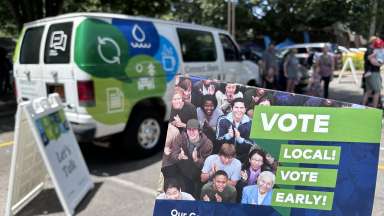
Vote Local Flyer with the community engagement van behind

Vote Local: Our Community, Our City, Your Vote!

City Council sets policies that shape Raleigh


Jump To:

 
Ordinance (2024) 627 – City Council and Mayoral Term Changes Two-Phase Implementation Your Guide to the New Staggered Terms Raleigh's Government Photo ID Requirement Voter Registration and Polling Places Early Voting

Ordinance (2024) 627 – City Council and Mayoral Term Changes

In 2026, City Council districts will hold non-partisan primaries on March 3. The two candidates in each district who receive the most votes will advance to the general election in November.  

Ordinance (2024) 627 extends the terms for the Mayor and all City Council Members to four (4) years. To maintain staggered terms, half of the City Council seats will expire every two (2) years. 

Two-Phase Implementation

Phase One – 2026 Election

  • All seats for the Mayor and City Council will appear on the 2026 ballot.
  • Voters will elect:
    • The Mayor, District A and B council members, and one at-large council member to four-year terms
    • The remaining City Council Members to two-year terms. This is one at-large council member and members from Districts C, D, and E.
  • For At-Large City Council seats:
    • The candidate receiving the highest number of votes will be elected to a four-year term
    • The candidate receiving the second-highest number of votes will be elected to a two-year term

Phase Two – 2028 Election 
 

  • Seats filled with two-year terms in 2026 will be up for election again 
  • Voters will elect City Council Members to serve four-year terms

Ongoing – Starting in 2030 

Half of the City Council will be elected every four (4) years, maintaining staggered terms. 

Your Guide to the New Staggered Terms

 Phase One
Nov. 2026
Phase Two
Nov. 2028
Nov. 2030
Mayorfour-year term Not on Ballotfour-year term 
At Large (1st Place)four-year term Not on Ballotfour-year term 
At Large (2nd Place)four-year term four-year term Not on Ballot
District Afour-year term Not on Ballotfour-year term 
District Bfour-year term Not on Ballotfour-year term 
District Ctwo-year term four-year term Not on Ballot
District Dtwo-year term four-year term Not on Ballot
District Etwo-year term four-year term Not on Ballot

Raleigh's Government

The decisions that shape Raleigh begin with YOU! In a council-manager form of government, the people elect the council and mayor. The City Council then sets policies that impact your day-to-day life. This includes policies such as resolutions on transportation, housing, services, and infrastructure.

The City Council consists of eight members. Three of the members, including the mayor, are elected at large (this means they represent the entire city). Each of the other members are elected to represent one of five districts: A, B, C, D, and E. Each district covers a geographic region of the City. The City Council then serves as the legislative body and appoints a city manager to oversee day-to-day operations. The city manager then proposes the operating budget and implements city council policy and initiatives.

Raleigh Skyline

Photo ID Requirement

North Carolina requires photo ID for voting. Most voters will simply show their driver’s license. But there are many other acceptable photo IDs. If a voter does not have an acceptable photo ID, they can get one for free from their county board of elections. Learn more at Get a Free Voter Photo ID. Voters can also get a free ID card from the N.C. Division of Motor Vehicles (NCDMV). Find more information under “No-Fee ID Cards” at State IDs | NCDMV.

Voter Registration and Polling Places

It is quick and easy to update your voter registration, find your polling place, or see who is running in your district. For all of this and more, visit the Wake County Board of Elections.

Early Voting

More information on early voting will be available closer to the election. Check back soon!

Related Events

  All events