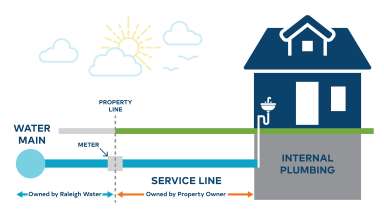
water service line graphic

Understanding Lead and Raleigh's Water System

The History and Future of Our Water System

Raleigh is a city defined by its growth, and our water infrastructure tells that story. From the historic homes near the Capitol to vibrant new developments, our pipes serve as the literal "veins" of the community.

Welcome to Your Water Safety Hub

Raleigh’s water has always been high-quality, and we're working hard to keep it that way for generations to come. We’re currently hard at work on our Service Line Project, an initiative to identify and update water pipes to ensure every drop reaching your tap is as safe as possible.

Want to get involved or just stay in the loop? Here’s how we can help:

  • FAQs & Expert Tips: Simple steps you can take to maintain your home’s plumbing and keep your family healthy.
  • Project Updates: See exactly what Raleigh Water is doing to keep lead out of the drinking water in our service area.
  • Watch Our Video: Learn more about the service line project and what it means for you and your family.

A Brief History of Lead and Plumbing

For decades, the drinking water industry has evolved alongside building standards. In the late 1800s and early 1900s, lead was often used in plumbing because it was durable and easy to bend. However, by the mid-20th century, materials like galvanized iron and copper became the industry standards. 
 

In 1986, the Environmental Protection Agency (EPA) banned lead solder in plumbing systems. Because much of Raleigh’s growth exploded in the decades following this ban, a large majority of our local infrastructure was built using modern, lead-free materials. 

Check out episode two of the Your City, Answered podcast that addressed lead in water lines.

Raleigh's Track Record of Safety

While the 2014 Flint water crisis rightfully caused communities across the country to look closer at their pipes, Raleigh Water has been proactive for decades. Since 1991, we have been required by the Federal Safe Drinking Water Act to monitor "Tier 1" sites—homes with copper plumbing and lead solder installed before the 1986 ban—to ensure our water remains safe. 
 

The results are clear: Raleigh Water remains in full compliance with all federal and state rules. Our most recent sampling in the summer of 2025 shows that our water meets or exceeds all rigorous safety standards.  

How Raleigh Water Protects You Every Day

Lead doesn't usually start in the water; it enters the water if it dissolves from older private pipes or fixtures. To prevent this, Raleigh Water uses industry best practices to treat our water before it ever reaches your home: 

  • Corrosion Control: We optimize the pH of our drinking water and add corrosion inhibitors. This makes the water "less hungry," creating a protective coating inside pipes that prevents metals like lead and copper from leaching into the water. 
  • Asset Management: We don't just wait for problems; we look for them. Our robust Asset Management Program actively replaces aging underground infrastructure, specifically targeting older galvanized iron service lines in neighborhoods built prior to 1960. 

The Path to Progress: Modernizing Our Region

Today, we are moving into the next chapter of our history. While there are no known lead service lines in our area, the EPA’s updated Lead and Copper Rule requires a comprehensive inventory of every connection, including both the city-owned and privately-owned sides. 
 

Modernizing our system is about data and transparency. By identifying the materials in every home, we can move away from old paper records and into a high-tech, digital map that ensures the health of our community for the next hundred years. 

Verify Your Home’s History

If you are uncertain about the materials in your plumbing system, you can take action today: 

  • Check the build date: If your home was built after 1986, your risk is extremely low.
  • Request a Free Test Kit: We offer free testing to our customers. (Please allow 5-10 business days for delivery and an additional 5-10 days for results). 
     

Share Your Story (Submit Your Results): Email  customercare@raleighnc.gov. Please share your name, address, method you used to verify the service line material and results. Someone will respond to confirm receipt of the information within 5 business days. 

Contact Us

Need more information about Raleigh Water’s Service Line Material Project? Our team is available to answer questions about the federal regulations or help you identify your pipe type. 

Raleigh Water Customer Care 

  • Phone: 919-996-3245 
  • Share Your Results: Email  customercare@raleighnc.gov. Please share your name, address, method you used to verify the service line material and results. 


  • Specific Project Inquiries For detailed questions regarding the Lead and Copper Rule (LCRR) inventory: Email  customercare@raleighnc.gov. Please include "Service Line Project" and your address in the subject line and share your name, address, method you used to verify the service line material and results. 

Sample Email Template

Subject: Service Line Project 

Body: 

Hi Raleigh Water Team, 

I am submitting my service line material information for your inventory project. Here are the details for my property: 

  • Property Address: [Enter your full address here] 
  • Pipe Material Identified: [e.g., Copper, Plastic, Lead, or Galvanized Steel] 
  • Test Performed: [e.g., Magnet test, Scratch test, Visual inspection or Plumber verified] 

I have attached a photo of my service line where it enters the house (near the shut-off valve/water meter) for your review. 

Please let me know if you need any further information to update my property's records. 

Thank you, 

[Your Name] [Your Phone Number] 

Tips for a Great Photo: 

  • Clear View: Make sure the area you scratched or tested is visible and in focus. 
  • Context: Try to include the main shut-off valve in the frame so the team can verify the location. 
  • Lighting: If your pipe is in a dark crawlspace or basement, using a flashlight or your phone's flash will help the team identify the color of the metal. 

Contact


Kimberly Holmes-Iverson
Communications Manager, Raleigh Water
kimberly.holmes-iverson@raleighnc.gov

Lead Department:
Water

Subscribe