
Jump To:
Raleigh is considering a temporary six-month pause on development approvals for data centers. Council will hold a hearing at its Oct. 6 meeting. The pause will allow the City to study the unique impacts of major data centers on surrounding properties and the City’s resources, and adopt regulations to address those impacts. Based on current North Carolina law, the City’s Unified Development Ordinance (which guides how land and buildings are developed, see below) cannot ban data centers. Therefore, the intent of this moratorium is to ensure that data centers can be properly regulated and the public health and safety are protected.
What is a data center?
A data center is a facility that houses computer systems used to store, process, and manage digital information. Data centers help power many of the online services people and businesses use every day. Data centers typically have infrastructure such as air handlers, power generators, and cooling systems to ensure continuous operation. In Raleigh, larger data centers can only be built in certain places and require a special permit (see below). The moratorium pauses that application and review process.
What kinds of data centers does Raleigh allow?
There are two types of data centers:
1. Minor data centers
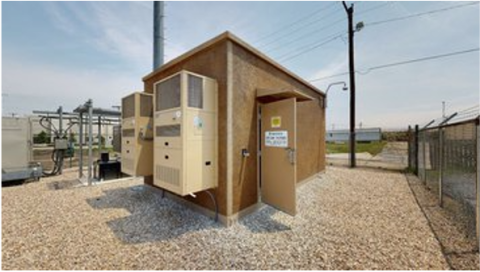
Classified as Minor Utilities under the City’s Unified Development Ordinance, these small facilities are 10,000 square feet or less with low peak electrical demand and water use. They have minimal impact and are allowed in all zoning districts.
Minor Utility Data Center located at 6011 Chapel Hill Road, Raleigh, NC. This is a small-scale edge data center operated by American Tower at the base of their cell towers. This data center is located in the IX- Zoning District, is under 10,000 SF in size (both land and building footprint).
Photo credit: Google Earth
2. Major data centers
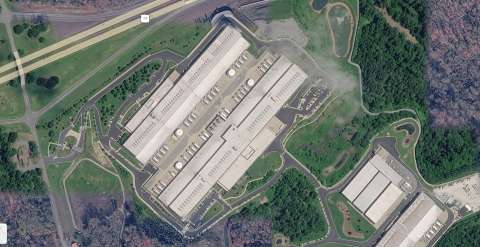
Classified as Major Utilities under the City’s Unified Development Ordinance, these larger facilities include the big “hyperscale” centers seen in the news. These can only be built in industrial zones and must go through a Special Use Permit process.
Hyperscale Data Center located at 404 Social Circle, Forest City, NC, in Rutherford County. This is a Meta-operated facility comprised of two 370,000 SF buildings. This type of facility would constitute a Major Utility Data Center under the City’s UDO, and would require a special use permit approval prior to construction.
Photo credit: Google Earth
What’s the UDO?
The Unified Development Ordinance is the list of rules that guides how land and buildings are developed, used, or subdivided. In the case of data centers, it says that a special use permit is needed to construct a major data center in only two zoning districts.
Does Raleigh have data centers?
Yes. Raleigh has several smaller data centers that support businesses and digital services. Raleigh does not currently have any hyperscale data centers. Locating a major data center requires a special use permit (see below).
Where can major data centers be located?
Only in industrial zoning districts – Industrial Mixed Use (IX-) and Heavy Industrial (IH-) – and only after receiving a Special Use Permit. Read more about zoning.
What is a Special Use Permit and when is it required?
A Special Use Permit is required for Major Utility data centers (those exceeding Minor Utility thresholds) to locate in Industrial Mixed Use (IX) or Heavy Industrial (IH) zoning districts. The permit may be granted by the Board of Adjustment after an evidentiary hearing. This is when the applicant must demonstrate compliance with zoning regulations and compatibility with surrounding uses. The permit must be granted by law if all required UDO standards, detailed in the next question, are met.
How does the Special Use Permit process work?
The Board of Adjustment holds a quasi-judicial evidentiary hearing to review the application. A quasi-judicial hearing is a court-like proceeding where the Board sits as quasi-judicial judges to hear and review evidence. Decisions must be based on competent, material, and substantial evidence entered into the official record at the hearing, and not on speculation, conjecture, or public opinion. In order to be granted a Special Use Permit approval, the applicant must prove that the proposed data center:
- Meets all zoning requirements;
- Is allowed as a special use in the zoning district;
- Complies with specific use standards;
- Is compatible with nearby uses;
- Mitigates any adverse impacts;
- Provides adequate access and safety;
- Has appropriate signage; and,
- Makes necessary public dedications of streets and utilities as required by code before building permits are issued.
It is the applicant’s burden to put sufficient evidence into the record in order for the Board to determine whether the above standards are met. The Board of Adjustment may attach reasonable and appropriate conditions and safeguards to a permit approval if such conditions and safeguards are related to the impacts of the specific project being requested.
BOA meetings are open to the public and typically occur on the second Monday of each month. Meeting dates and agendas are posted on the City’s Boards and Commissions website. Properties within 100 feet of the proposed site receive mailed notice of the application. While the public can attend BOA meetings, and offer relevant, fact-based testimony, general public comment is not part of the special use permit process.
What would the proposed moratorium do?
If adopted, the moratorium would temporarily pause the City’s acceptance and review of applications for data center development approvals. This would include, but not be limited to, the Special Use Permit needed for a major data center to be built. The pause would last for the length of the moratorium.
What happens during the moratorium?
City staff, including the Planning and Development Department, will bring forward proposed regulations to mitigate impacts of large-scale data centers. These would go through the regular Unified Development Ordinance text amendment process, so the public will have multiple opportunities to comment throughout this time.