
Jump To:
Designation Documents
East Raleigh-South Park is Raleigh's largest historic African American neighborhood.
Period of Significance: 1855 – 1953
Properties with a contributing status in the district may be eligible for the federal and state historic tax credit programs. Visit the Historic Property Tax Credit webpage for more information.
History
East Raleigh includes several platted areas, including the Smith-Haywood and Saint Petersburg neighborhoods that developed after the Civil War. Real estate developers were both African American and white.
Most of the district is historically African American. The area north of East Davie Street, as well as sections of Smithfield (now Western Boulevard) and South Blount Streets, were occupied by White people until the 1930s and 1940s. A few antebellum houses in the neighborhood, like the ca. 1855 Rogers-Bagley-Daniels-Pegues House at 125 East South Street, also remain, recalling land uses before the war when large estates stood at the fringes of Raleigh.
African Americans moved into Raleigh in increasing numbers after the Civil War. Many were attracted to the southeastern part of Raleigh for its association with three prominent institutions located here: Second Baptist Church (now Tupper Memorial), which offered classes for African Americans of all ages; Shaw Collegiate Institute (now Shaw University); and the School for the Negro Deaf, Dumb, and Blind. Immediately after the Civil War, many African Americans rented small houses built on newly subdivided land sold by cash-poor White people. Soon, as opportunities – particularly educational options – expanded for African Americans and the middle class grew, houses became more fashionable, built in popular styles like Craftsman, and more often owned by residents. Shaw, in particular, produced local leaders representative of the growing African American professional community and middle class.
The presence of Shaw University and the growing middle class that chose to live nearby helped make Raleigh, and East Raleigh in particular, a cultural center for African Americans as early as the 1890s.
Subdivision of the South Park area began in 1907. Originally intended as another white streetcar suburb, like Glenwood-Brooklyn and Boylan Heights, the white real estate developers decided to market the area to African Americans instead, given the proximity to Shaw University. South Park includes Craftsman, Colonial Revival, and Neoclassical houses.
Historic District Map
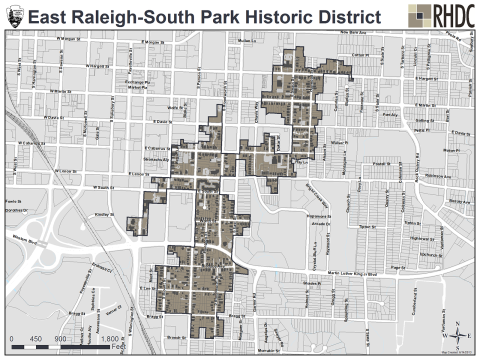
This National Register district map is provided for illustrative purposes only and does not represent the official zoning map, which is maintained in iMaps.
A portion of the East Raleigh-South Park National Register Historic District is also designated as part of the local Prince Hall Historic Overlay District (HOD). HODs are a separate type of district from the National Register. HODs are zoning overlays designated by the Raleigh City Council. It has different rules, benefits, designation process, and sometimes boundaries.
Physical Description
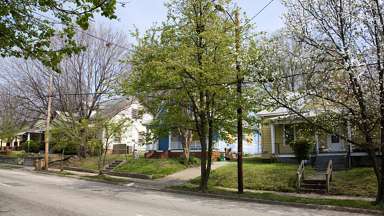
The East Raleigh-South Park Historic District is a collection of African American neighborhoods that developed from just after the Civil War through the first decades of the 20th century. The 30-block area lies east and south of downtown Raleigh and is predominantly residential with working-class and middle-class housing stock, churches, and small grocery stores. Houses are densely packed and sometimes close to the street, with well-kept yards and flower gardens.
The oldest section is north of South Street and west of East Street, inside Raleigh's original city limits. Many houses date from the 19th century; the oldest dates to 1850. Vernacular house styles are prevalent, for example, Shotguns and Triple-A cottages with mass-produced architectural detail applied. Porches, porch railings, and attic vents are examples of applied detail.
Other common house types, particularly in the 20th century, include side-gabled, front-gabled, and hipped-roof houses that are three rooms wide and two or three rooms deep. There are a few I-houses, a wide and shallow side-gabled two-story house type often seen in rural areas. A few houses have attached grocery stores. Corner groceries are also present.