You’ve heard it before, every drop of water counts, especially as the City of Raleigh lifts water restrictions. Raleigh Water is leading by example by recycling water residuals to supplement supply. That sounds impressive, but what does that mean? To understand the process and how it’s saving the City water. We need to understand that our drinking water plants clean the water which creates water residuals. In simple terms residuals are the byproduct of the water treatment process, which contains solid particles, organic compounds and dissolved metals that have been removed from the lake water. That might have you asking, ‘where do the residuals go after being removed from drinking water?’ Some residuals are sent to the sewer, some are land applied and some go to a landfill.
If you didn’t’ know Raleigh Water has two drinking water treatment facilities: E.M. Johnson and Dempsey E. Benton, both facilities recycle water residuals.
Here’s where the cool part comes into play. Raleigh Water is taking those residuals and sending them to a dewatering facility or back to the start of the water treatment plant to undergo even more treatment (it is not sent directly into the drinking water supply.)
E.M.J. recycles almost all its leftover water.
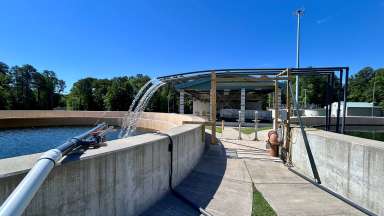
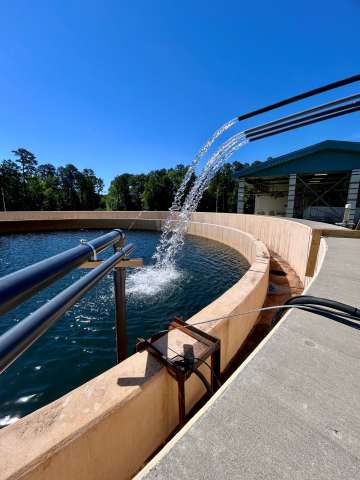
D.E.B. has two types of process waste streams. Filter backwash water which is recycled using a process called Dissolved Air Flotation to remove particles and water from sedimentation basins which then go to a thickener. The thickener allows for the heavy particles to settle at the bottom and cleaner water to rise to the top.
Thanks to recycling water residual project Raleigh Water created at D.E.B. the water from the top of the thickener is being treated and sent back through the treatment process instead of being released into the sewer.
Let’s look at some of the numbers with water residuals and what that means for you.
The numbers:
· In June, about 5.3% of all the water used at both plants came from recycled leftover water instead of new water.
· That's about 3.65 million gallons every day (MGD).
· So far, that's a total of 80.293 million gallons recycled.
For the thickener effluent project alone its over 400,000 gallons per day.
· For comparison, the median single-family home in the Raleigh Water uses about 100 gallons per day. So that water savings can provide water for 4000 homes!
"It's been an engaging, but worthy challenge that combines problem solving and a responsible usage of our water resources, I'm very proud to have been a part of it." - Blake Foster, DEB Chief Operator
Currently, the project is being adapted and refined daily as the crew continues to learn, improve, and do their part to conserve water, especially during this drought.
Every drop counts, especially as the water restrictions are lifted. You can make a difference with even the simplest actions, like turning off the water while you brush your teeth. Water conservation is essential right now, and Raleigh Water is leading by example.