
Jump To:
When the fire department arrives at a building fire, they have descending set of priorities: life safety, incident stabilization, and property conservation:
- Life Safety - ensuring that all occupants are safely removed from the building, through both evacuation and rescue. Firefighters conduct primary and secondary searches inside the building and check all areas;
- Stabilization - involves controlling and extinguishing the fire. This also involves protecting exposures, which refers to nearby buildings or other structures in danger of also catching fire; and,
- Property conservation - involves actions to reduce or minimize the damage caused by fire, water, and smoke.
Fires within one or two rooms inside a building are typically fought as an interior or offensive attack. Firefighters take their hoses into the structure, and extinguish the flames inside the rooms.
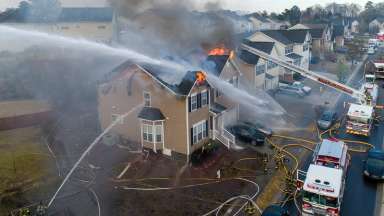
Larger fires, such as involving an entire attic space or the upper-story of a building, are typically fought as exterior attack, this is also called defensive operations. Exterior attacks include hand hose streams, larger portable ground-based nozzles, and water streams from aerial devices.
Ventilation is an equally important tasks where firefighters use natural openings (doors or windows) or create openings (roof holes) to help remove smoke and heat from inside a structure. By doing so this helps firefighters search for occupants, and easily locate the seat of the fire.
The incident commander, also called command, supervises operations at a fire. Each company has a specific role, including fire attack, search and rescue, ventilation, rapid intervention team (one company ready to rescue any firefighters who become trapped), and safety (assessing hazards at the fire, such as downed power lines).
Water is carried by each engine company, with 500 gallons on each unit. While that amount is sufficient for most one- or two-room fires, the engine also connects to the nearest fire hydrant. This is called catching a hydrant. By connecting to a hydrant, the engine has an unlimited supply of water. Greater quantities of water are needed for larger fires. Additional engines may connect to the same hydrant to boost pressure.
What Happens After Someone Reports a Fire?
Have you ever wondered what happens when a structure fire is reported to the Raleigh Fire Department?
While each call is unique, the standard response to a structure fire call in the City of Raleigh involves the following steps:
Dispatch
The Raleigh/Wake County Emergency Communications Center receives a call reporting a structure fire. The dispatcher collects essential information about the location, type of structure, and any known hazards.
Alerting Fire Stations
The dispatcher alerts the nearest fire stations to respond to the incident.
Fire units are notified of emergencies by two-way radio. Each unit has a different radio tone, which activates a buzzer and overhead lights at the fire station. The tones are followed by an automated voice dispatcher that states the type of emergency, the street address, the responding units, and the radio channel. This information is also received at the fire station on both printer and an alphanumeric pager. A number of fire units also have mobile data terminals that display emergency call information from within the fire apparatus.
En Route
Firefighters quickly respond to the scene, activating lights and sirens as needed to navigate through traffic safely. When responding to emergencies, fire units can proceed through red lights and stop signs as long as they stop first and see their way clear. It is important for all motor vehicles to pull to the right when an emergency vehicle is approaching from behind them with flashing lights and siren. They use the most efficient route based on real-time traffic conditions. Raleigh Fire’s first engine arrives on scene in four minutes or less.
Standard Response
Raleigh Fire sends four engines, two ladders, the heavy rescue, two Battalion Chiefs, and the Incident Safety Officer to all reported structure fires. If the fire is confirmed to be a “working” fire, the Division Chief, another Battalion Chief, an air unit, and fire investigators are added to the call. Depending on the nature of the incident, Raleigh Fire’s Public Information Officer and department chaplain will also be added to assist on scene, as needed.
Assessment
Upon arrival, the Incident Commander (usually the first officer to arrive) conducts a thorough assessment. They evaluate the situation, identify immediate threats to life or property, and determine the best strategy for firefighting operations. If there is not a working fire, units that are not needed are canceled and can return to the station.
Fire Suppression and Search and Rescue
If the Incident Commander upgrades the call to a working fire, firefighters begin deploying hose lines, conducting search and rescue operations, ventilating the structure, and establishing a water supply immediately. Firefighters work to extinguish the fire using various firefighting techniques, depending on factors such as fire size, building construction, and potential hazards. Simultaneously, firefighters conduct a thorough search of the structure to locate any occupants or pets who may be trapped or in need of assistance. Rescued individuals are quickly moved to safety and provided with medical attention by EMS units, if required.
Ventilation
Proper ventilation is crucial to remove smoke, heat, and toxic gases from the structure, improving visibility for firefighters and increasing the effectiveness of fire suppression efforts.