
Jump To:
Designation Documents
Vanguard Park contains housing stock in a variety of popular styles from the 1920s through the 1950s (developed with racially restrictive covenants).
Period of Significance: 1920 – 1952
Properties with a contributing status in the district may be eligible for the federal and state historic tax credit programs. Visit the Historic Property Tax Credit webpage for more information.
History
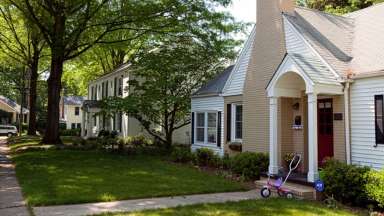
Despite other similarities to nearby Roanoke Park, Vanguard Park lacks the vernacular house types found in the earliest section of its neighboring suburb. Construction began in this district along its south and west edges in 1920 with modestly sized bungalows and front-gabled houses dressed in the nationally popular Craftsman style. Construction slowed considerably during the Depression years of the early 1930s, but building did continue in Vanguard Park. A few pared-down Craftsman houses were erected, and a new style well-suited to the neighborhood was on the rise. Period Cottages, essentially a simplified version of the Tudor Revival style popular in the 1920s, were built in the south end of Vanguard Park, mixed with other architectural styles. Identifying features of the Period Cottage include asymmetrical facades, steep gable roofs, arched entrances, and brick or stone chimneys prominently located on the front elevation.
In the later years of the 1930s and into the very early 1940s, one- and two-story houses filled parts of Hudson Drive and Reaves Street. These houses adopted the Minimal Traditional style, an austere architectural idiom that sparingly used Colonial Revival details, such as small pedimented porches or pedimented door surrounds. Construction stopped abruptly during World War II, only to rebound robustly in the post-war housing shortage. Nearly 50 houses went up in Vanguard Park between 1945 and 1952. Pine Avenue filled up in a single year, 1950, with houses to meet the demand. Most of these early post-war houses are Minimal Traditional.
Employment centers for wage-earners in the neighborhood were virtually all south of Vanguard Park, reached in the neighborhood's earliest years by the streetcar line. Clerks working in retail and varied professionals commuted to the commercial and government districts centered on Fayetteville Street, while blue-collar workers and tradesmen worked in the warehouses and small factories east of the central business district. Like other neighborhoods surrounding Five Points, Vanguard Park was developed with racially restrictive covenants intended to limit home ownership in the area only to white people.
Historic District Map
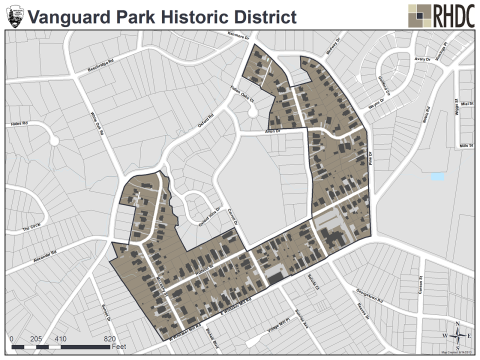
This National Register district map is for illustrative purposes only and is not the official zoning map, which is maintained in iMaps.
Physical Description
Situated between Bloomsbury and Roanoke Park in Raleigh's Five Points area, Vanguard Park features rolling topography and early-20th-century housing stock similar to the neighboring districts. Residential buildings are generally single-family dwellings; duplexes and apartment buildings were erected here near the middle of the 20th century. Gothic Revival Westminster Presbyterian Church, formerly North Vanguard Church, is the sole institutional building in Vanguard Park.
Vanguard Park, like Roanoke Park, contains housing stock rendered in a variety of popular architectural styles and types from the 1920s through the 1950s. They are the same styles and types found in the nearby prestige suburb of Hayes Barton, executed on a more modest scale. Notably, however, the popular Colonial style was omitted due to Vanguard Park's narrower house parcels. Real estate developers capitalized on the proximity to the Hayes Barton suburb when marketing house parcels in these areas, appealing to up-and-coming homebuyers.