
Jump To:
Designation Documents
Saint Mary's is the oldest school for women in North Carolina and the oldest continuously operating school in Raleigh.
Period of Significance: Established in 1842
Properties with a contributing status in the district may be eligible for the federal and state historic tax credit programs. Visit the Historic Property Tax Credit webpage for more information.
*In 1998, St. Mary’s College transitioned back to a high school and renamed the institution as St. Mary’s School to match its new status. The National Register designation information has not been updated to reflect this decision.
History
The three oldest buildings on campus, East and West Rock buildings and Smedes Hall, were built for an Episcopal boys' school established in 1833. That school was short-lived: financial difficulties closed it in 1839. Saint Mary's School for Girls, also associated with the Episcopal Diocese, was established in 1842 and has continued operating ever since.
The physical campus grew gradually, first in the Gothic Revival and Carpenter Gothic styles and later, particularly in the early-20th century, in the Colonial Revival style. The school focused on maintaining existing buildings rather than resorting to demolition and rebuilding. This policy has resulted in a remarkably intact record of the physical evolution of the school.
Unlike its predecessor, the girls' school was immediately successful, educating young women from all over the South as well as a few northern states. Day students also attended, and the student population averaged about 90 boarders and 40 day students in the 19th century. A student entered the school as young as 8 years of age and stayed as long as her parents wished her to be educated in basic academic subjects, music, art, and foreign languages.
In the antebellum period, Saint Mary's was also a cultural center of Raleigh, hosting musical recitals and dinners. The school remained in operation during the war, sometimes providing refuge to prominent Confederates. The family of Jefferson Davis spent several weeks in residence at the school, and student enrollment included Robert E. Lee's youngest daughter. In April 1865, federal troops camped here without incident.
In the 20th century, Saint Mary's began offering more of a structured collegiate experience. In the late-20th century, the school offered the last two years of high school and the first two of college. By the early-21st century, the school became a high school only. It remains a private girls' school.
Historic District Map
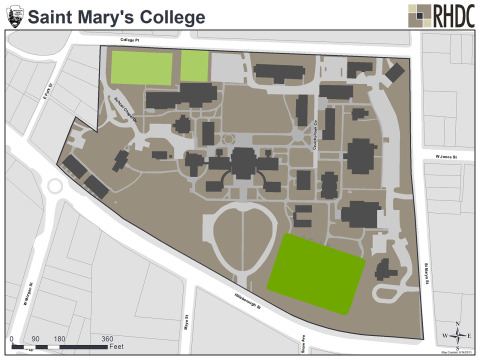
This National Register district map is for illustrative purposes only and is not the official zoning map, which is maintained in iMaps.
Physical Description
Buildings from the 19th and 20th centuries populate Saint Mary's sylvan campus, including antebellum structures individually recognized as local Raleigh Historic Landmarks. A triptych of buildings from the 1830s is visible from Hillsborough Street from behind a wooded glade populated by mature oaks, hollies, and magnolias.
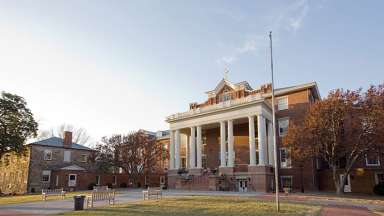
The school's oldest structures, East and West Rock, are matching buildings of stone that were discarded during the construction of the second State Capitol in the 1830s. Within a few years, the brick Greek Revival building between them was erected. This main building was remodeled in 1907 with the addition of the Neoclassical Revival front portico and dormitory wings, and was named Smedes Hall for the girls' school's first president.
Two buildings erected in the later-19th century are Gothic in style: the 1855 Richard Upjohn Carpenter Gothic Chapel and the 1887 Gothic Revival Language Arts building, a brick structure with pointed-arch windows.
The early-20th century saw a flurry of construction. Virtually all the permanent brick buildings, which were rendered in the Colonial Revival style, survive. Later construction continued to complement earlier buildings, and the view of the campus from Hillsborough Street remains notable for its historic integrity.