
Jump To:
Designation Documents
Saint Augustine's College is a monument to the education of African Americans after the Civil War.
Period of Significance: 1867 – 1930
Properties with a contributing status in the district may be eligible for the federal and state historic tax credit programs. Visit the Historic Property Tax Credit webpage for more information.
*In 2012, St. Augustine’s College transitioned in name and status to St. Augustine’s University. The National Register designation information has not been updated to reflect this decision.
History
The Freedman's Commission of the Episcopal Church founded Saint Augustine's in 1867, part of the church's missionary work in the Reconstruction era. The school helped establish Raleigh as a center of educational opportunity for African Americans. The early instructional program focused on technical and trade education, including teaching and nursing, as well as ministerial training for the Episcopal priesthood.
While the church's support of the school provided much-needed opportunities for African Americans, the training of teachers, nurses, and priests also furthered the segregation practices that characterized the first half of the 20th century. Administrators at the school were predominantly white from the early years of the school through the middle of the 20th century.
The establishment of training for nurses coincided with the opening of Saint Agnes Hospital in 1896. Saint Agnes provided hospital care for African Americans and a training opportunity for Saint Augustine's nursing students. Like the administrative staff of the college, much of the medical staff at the hospital was white and male. Notable exceptions included the hospital's first attending physician, Dr. L. A. Scruggs, and several female doctors who worked on staff, often in charge of the nurses, in the first half of the 20th century.
In the 1920s, the institution's focus shifted to the provision of a liberal arts higher education. The class entering in the fall of 1927 was the first to have a four-year college curriculum available to it. Four years later, Saint Augustine's produced its first 12 graduates. By the middle of the 20th century, the model farm had been eliminated, as had all sub-college-level offerings.
Throughout its history, the school also had a strong effect on residential patterns in southeast Raleigh, as African Americans relocating to the city elected to live near the college in the adjacent neighborhoods of Idlewild and College Park.
Historic District Map
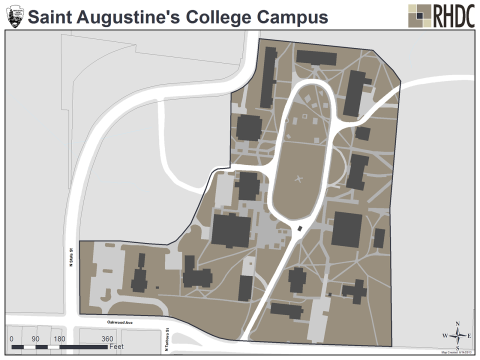
This National Register district map is for illustrative purposes only and is not the official zoning map, which is maintained in iMaps.
Physical Description
Immediately following the Civil War and the abolition of slavery, Saint Augustine's opened as a normal school to train African American teachers. The school evolved into a college providing higher education for African Americans. The historic campus has both a Gothic and Romanesque tone, with stone buildings as well as brick buildings with classical elements.
The early campus clustered on Oakwood Avenue and grew to 110 acres by 1897. Much land remained undeveloped for academic use and was devoted to agriculture instead. The growth of the student body in the early 20th century led to a building boom, including the 1909 Saint Agnes hospital, the 1924 C. R. Hunter Building, and the 1925 Tuttle Building, which housed a training school for church and social work. The college established a model farm in the 1920s, which included a house, cultivated fields, and livestock.
In the mid-1920s, the trustees elected to pursue a full college course. Another building boom followed in the 1930s, and Saint Augustine's had a well-developed campus by 1937. The campus has since doubled in size. As newer buildings replace the oldest structures, the architectural variety that has always characterized the campus remains.