
Jump To:
Designation Documents
A White middle-class neighborhood emulating nearby upper-middle-class Hayes Barton (developed with racially restrictive covenants).
Period of Significance: 1913 – 1952
Properties with a contributing status in the district may be eligible for the federal and state historic tax credit programs. Visit the Historic Property Tax Credit webpage for more information.
History
Six separate plats, filed from 1913 to 1926, make up what is now the roughly diamond-shaped Roanoke Park neighborhood. Some of the oldest houses in Five Points are here, built around 1915 on Sunrise Avenue. These vernacular house types include side-gabled Triple-A cottages, so named for the third, decorative gable centered at the facade; front-gabled and hip-roofed bungalows; and narrow, front-gabled shotguns. Vernacular houses like these are rare in Five Points, where the popular architectural styles of the 1920s predominate. The Sunrise Avenue plat was the first filed in the district.
Developers platted the district's eponymous subdivision, Roanoke Park, in 1922. The real estate promoters appealed to white first-time homebuyers and bragged about the suburb's location next to Hayes Barton. This section of the neighborhood centers on the park and features the largest period revival houses, emulating the design seen in Hayes Barton. Later subdivisions in the district filled with Craftsman bungalows and, in the years following the Depression and World War II, the simple, small house style derived from the Colonial Revival known as Minimal Traditional.
The neighborhood historically housed middle-class families where the primary wage-earners worked in a variety of blue-collar and white-collar jobs. Mechanics and construction trade workers likely worked in the nearby industrial corridor south of the neighborhood. Shop owners, clerks, and professionals probably rode the nearby streetcar down Glenwood Avenue to downtown jobs. As automobile ownership rose, detached single-car garages more often accompanied the houses built here. Unlike other Five Points neighborhoods, Roanoke Park does not have service alleys.
The neighborhood, like others in Five Points, was generally built out by the middle of the 20th century, as the popularity of the low-slung Ranch house was on the rise. A few 1950s Ranch houses stand in the neighborhood. Roanoke Park has remained a stable and popular neighborhood in Raleigh.
Historic District Map
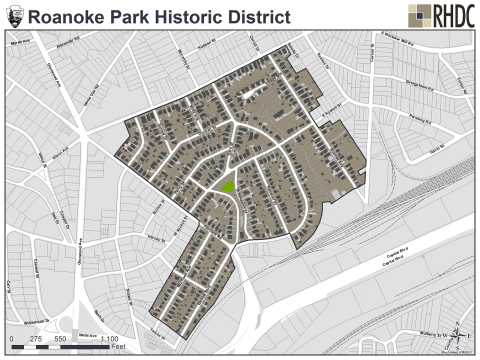
This National Register district map is for illustrative purposes only and is not the official zoning map, which is maintained in iMaps.
Physical Description
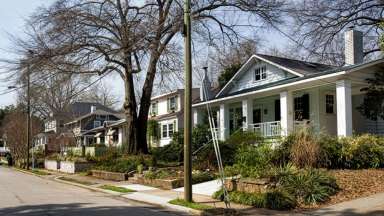
Roanoke Park is one of the Five Points historic neighborhoods, situated southeast of the intersection. The densely packed neighborhood consists nearly exclusively of modest single-family homes. It resembles nearby Hayes Barton in architectural variety, but Roanoke Park's collection is decidedly more modest both in individual house size and decoration. With its earlier start in building, Roanoke Park also features some vernacular house types like the side-gabled Triple-A cottage as well as later vernacular styles like front-gabled and hip-roofed bungalows and narrow shotgun houses, particularly along Sunrise Avenue. But most common in Roanoke Park are houses with Craftsman detailing, including bungalows and Foursquares.
Roanoke Park's layout emulated the design of recent prestigious suburban developments. Streets followed the contours of the hilly terrain rather than conforming to an old-fashioned grid system. Streams and ravines offered opportunities for parks integrated into the street patterns; in Roanoke Park, the best houses line the park, bordered by Greenwood and Cherokee Drives. Concrete sidewalks made the neighborhood attractive for pedestrians even as automobile ownership was on the rise. House parcels are narrow but deep with relatively uniform and shallow setbacks, giving homeowners large backyard areas.