
Jump To:
Designation Documents
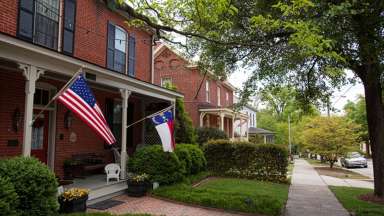
Oakwood contains Raleigh's largest collection of 19th-century Victorian-era dwellings and the richest overall diversity of architectural styles.
Period of Significance: 1880 – 1940
Properties with a contributing status in the district may be eligible for the federal and state historic tax credit programs. Visit the Historic Property Tax Credit webpage for more information.
History
Oakwood began as an early middle-class suburb, complementing the upper-middle-class suburbs along North Blount and Hillsborough Streets in the late 19th century. Unlike Raleigh's later suburbs, Oakwood developed slowly, often lot by lot rather than in platted sections. This almost continual development and redevelopment brought not only the solidly middle class, but also the lower middle and artisan classes. The oldest dwellings generally stand south of North and Lane Streets and west of East Streets; these streets mark the earliest city limits, and the houses here feature more high-style detailing than later houses. Several buildings are also individually recognized as local Raleigh Historic Landmarks (RHL).
As the population grew, the neighborhood pushed beyond the city limits. Vernacular houses went up, like the Triple-A cottages found at the south end of Elm Street and on Jones Street, where Elm Street terminates. Though much smaller than Oakwood's earlier houses, these dwellings blended well with the developing streetscape, matching the setbacks of the earlier houses and featuring similarly scaled front porches.
Development continued through the first decades of the 20th century, evidenced by popular architectural styles found mixed with Victorian styles. In the late 1960s and 1970s, the neighborhood went through a period of decline as families moved to newer suburbs north and west of the band of early-20th century suburbs. In the wake of suburban relocations, Oakwood became home to many LGBTQ+ owners and residents in the 1970s. Gay couples rehabilitated several dwellings.
When plans for a highway threatened to split Oakwood in two, those same gay residents led a grassroots effort to fight the project. They turned to the relatively new governmental historic preservation tools now at their disposal, listing Oakwood as both a National Register Historic District (NRHD) and a local Historic Overlay District (HOD). The highway that was planned to bisect Oakwood was scrapped.
Since its designation, Oakwood has seen a healthy amount of new construction on previously empty parcels and on newly subdivided sections. An example is the former site of the local Fallon's Flowers greenhouses at the east edge of the district, adjacent to the Victorian-era Oakwood Cemetery. The neighborhood is once again vibrant and stable.
Historic District Map
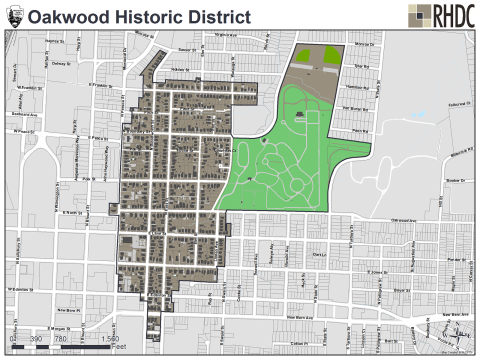
This National Register district map is for illustrative purposes only and is not the official zoning map, which is maintained in iMaps.
The Oakwood Historic District is also designated as a local Historic Overlay District (HOD). HODs are a separate type of district from the National Register. HODs are zoning overlays designated by the Raleigh City Council. It has different rules, benefits, designation process, and sometimes boundaries.
Physical Description
Oakwood is a large neighborhood teeming with architectural interest. Although the street plan is a strictly linear grid system, blocks and individual parcels vary in size and shape. Oakwood's rolling topography adds to the diversity of the landscape, with a mix of 1- and 2-story buildings throughout. The architectural variety of the Victorian period, combined with the emerging new styles popular in the early-20th century, creates a visually vibrant district.
The Victorian-era architectural styles seen in Oakwood include the Second Empire, found on the north side of East Jones Street between North East Street and Elm Street; Queen Anne, seen along Polk Street, especially east of North East Street; and Italianate, like the fine example with bracketed eaves and elegant bay windows on the north side of Polk Street, just east of North East Street. A small collection of 1-story, wood clapboard commercial building sit at the intersection of East Lane and North Bloodworth Streets. Most properties still retain their commercial uses.
Later infill brought the bungalow, the Foursquare, Craftsman style, and the Minimal Traditional house to Oakwood. Along Bloodworth Street north of Polk Street stand examples of a Craftsman bungalow, a simpler front-gabled bungalow, and a Minimal Traditional house with Colonial Revival details. Around the corner on Polk Street, west of Bloodworth, is another distinct Craftsman bungalow with stone accents and a deep, sheltered front porch.