
Jump To:
Designation Documents
Moore Square Historic District is home to Raleigh’s “Black Main Street” and the City Market.
Period of Significance: 1870 – 1940
Properties with a contributing status in the district may be eligible for the federal and state historic tax credit programs. Visit the Historic Property Tax Credit webpage for more information.
History
During the late-19th and early-20th centuries, small-scale commercial development replaced the earlier 19th-century residential district that had developed around Moore Square. As Raleigh's business district grew after the end of the Civil War, commercial development spread both east and west of Fayetteville Street, the city's main business thoroughfare.
Businesses lined South Wilmington Street as early as the 1870s. These tended to be saloons, cafes, grocery stores, blacksmiths, bootmakers, and boarding houses. The ca. 1870 Carolina Boarding House at the northeast corner of South Wilmington and East Hargett Streets is one of the older buildings in the district. It operated as a hotel and grocery before becoming a furniture store. For much of the 20th century, the Italianate building housed the Heilig-Levine Furniture Store.
Another surviving 19th-century building, although much altered, is the 1879 Tabernacle Baptist Church at the northwest corner of East Hargett and South Person Streets. Originally a modest brick Gothic Revival church, the building was remodeled into a Romanesque church late in the 19th century and back to a Gothic Revival building in the early years of the 20th century.
The 1914 construction of the City Market south of Moore Square had a profound impact on the streets surrounding the square. The growth of the trucking industry fueled the success of the market, which in turn generated a surge in the number of grocery stores on surrounding streets.
In the 1920s, increasingly stringent racial segregation practices pushed African American businesses out of several commercial areas, and they began relocating to East Hargett Street between South Wilmington and South Blount Streets. The block became Raleigh's Black Main Street. The Farmers and Mechanics Bank on East Hargett Street (just outside the Moore Square Historic District) helped finance many African American investments and businesses.
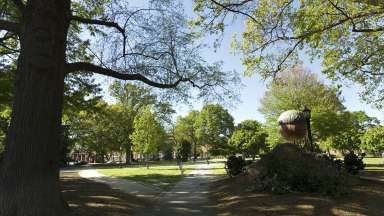
Like many urban neighborhoods in the second half of the 20th century, the area went into decline in response to the developing suburbs and suburban shopping centers. The last decade of that century and the early years of the 21st century have brought a robust resurgence to the streets surrounding Moore Square. In 2019, the City of Raleigh completed a large renovation of Moore Square. The redesign removed some of the park’s trees and now provides a large central lawn space and support facilities for community events.
Historic District Map
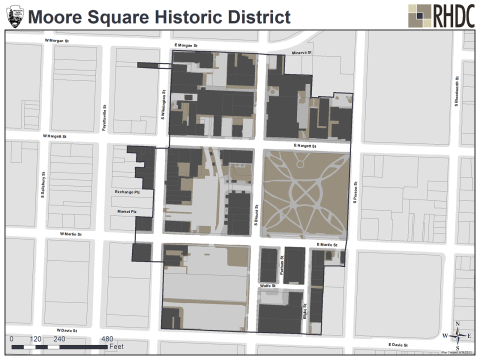
This National Register district map is for illustrative purposes only and is not the official zoning map, which is maintained in iMaps.
The Moore Square Historic District is also designated as a local Historic Overlay District (HOD). HODs are a separate type of district from the National Register. HODs are zoning overlays designated by the Raleigh City Council. It has different rules, benefits, designation process, and sometimes boundaries.
Physical Description
While the district is named for one of the five park squares laid out in the original plan of Raleigh, its character is overwhelmingly commercial. The area is close to South Raleigh's historically African American neighborhoods, and the proximity made the section of East Hargett Street between South Wilmington and South Blount Streets a center of African American-owned businesses. This section of East Hargett Street was known historically as Raleigh's Black Main Street.
Buildings date from the late-19th through early-20th centuries. Reflecting the size of the city around that time, they are small in scale and modest in detailing. An exception is the 1914 Mission-style City Market that faces Moore Square. The building reflects Raleigh's importance in agricultural trade in the early-20th century.
Heavy concentrations of 2-3 story brick commercial buildings line South Wilmington and East Hargett Streets. Smaller groups of similar buildings stand along East Martin and South Blount Streets. A notable infill project is the 1999 Exploris Museum at the corner of East Hargett and South Blount Streets, overlooking the northwest corner of the park; older infill includes parking decks and a bus transfer station.