
Jump To:
Designation Documents
Raleigh’s first subdivision developed by an African American for African Americans.
Period of Significance: 1960 – 1965
Properties with a contributing status in the district may be eligible for the federal and state historic tax credit programs. Visit the Historic Property Tax Credit webpage for more information.
History
Madonna Acres was established during the Jim Crow era of segregation, an inhospitable environment for the development of a modern residential subdivision for African Americans. Nearby, the development of Battery Heights and Rochester Heights attests to the demand for African American housing during this mid-century period. The platting of stylish Madonna Acres created a new opportunity for black homeowners with means to construct a new home on a spacious lot; the houses incorporated upscale amenities such as air conditioning, built-in intercom systems, and carports.
Madonna Acres was developed by John W. Winters, who descended from a Raleigh family of free Black people. During his 50-year career, which included tenure as the first Black Raleigh city councilor of the 20th century and a seat in the N.C. State Senate, Winters worked to improve life for Raleigh’s African American community. In 1957, as developers platted subdivisions to the north and west of the city, Winters saw an opportunity to develop a subdivision in predominantly Black southeast Raleigh. To that end, Winters founded the real estate and insurance business John W. Winters & Company. Madonna Acres was developed from 1960 to 1965 on land Winters acquired from the heirs of Bishop Henry Beard Delany, the country’s first African American Episcopal bishop and rector of St. Augustine’s Chapel.
Around two-thirds of the original residents worked in education, as faculty or staff at St. Augustine's College (now St. Augustine’s University), faculty at other colleges, public school teachers and principals, or staff of the North Carolina Department of Public Instruction. Occupancy of a significant number of properties continued into the second generation of the original residents’ families.
Historic District Map
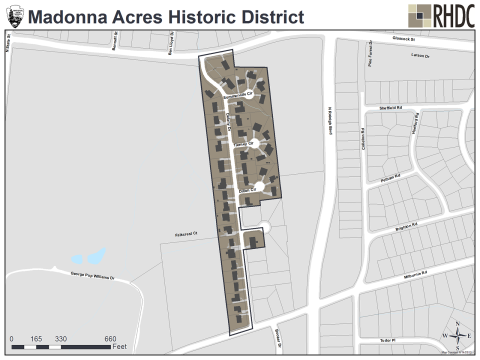
This National Register district map is provided for illustrative purposes only and does not represent the official zoning map, which is maintained in iMaps.
Physical Description
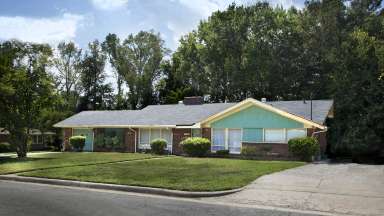
Platted in 1960 by African American developer John Winters, Madonna Acres is located on the eastern border of historic St. Augustine’s college campus in East Raleigh. The 13-acre subdivision is comprised of 40 custom homes built for middle to upper-middle-class African American families. The neighborhood has a level terrain with large grassy front yards bordered by flowers and shrubs. Mature trees are found in the backyards of properties. Built-in brick or stone planters and wooden flower boxes are common in the district.
Madonna Acres is a well-preserved collection of Ranch and Split-Level houses that contain Modern architectural elements, a progressive departure from the traditional styles and detailing found in White subdivisions of the same time period. The brick facades are decorated with accent walls of stone veneer or wood. The typical Madonna Acres Ranch is side-gabled with a living room picture window and an integrated one-car carport, although there are several asymmetrical front-gabled Ranches as well. The Split-Levels have a one-story main level with a living room, dining room, and kitchen, alongside a split-level two-story wing with bedrooms and a den.