
Jump To:
Designation Documents
Raleigh’s “Best Planned Suburb” (developed with racially restrictive covenants).
Period of Significance: 1938 – 1965
Properties with a contributing status in the district may be eligible for the federal and state historic tax credit programs. Visit the Historic Property Tax Credit webpage for more information.
History
Longview Gardens was developed from 1938 through the mid-1960s by Clarence Poe, civic leader and longtime editor of The Progressive Farmer. Poe began planning in 1924, aiming to create “Raleigh’s Most Beautiful Subdivision.” To help him achieve this, he hired Warren H. Manning, a well-known landscape architect and protégé of Henry Law Olmsted. Although Manning’s plan was never implemented, in 1937 Poe employed one of his assistants, Charles Gillette. A student of the City Beautiful movement, Gillette's design consisted of a pattern of curvilinear streets flanking both sides of a designed parkway. Civil engineer Louis E. Wooten of Edgecombe County, N.C., worked on the development’s topographic studies.
In the late 1940s, the Raleigh Country Club purchased a large tract of land within Longview Gardens for its new clubhouse and golf course, the latter of which was designed by famed golf course designer Donald Ross. The neighborhood is also home to two churches, Longview Baptist Church (1955) and the F. Carter Williams-designed Milner Memorial Presbyterian Church (1958), both striking Modernist structures.
Today, Longview Gardens remains largely intact with a high level of integrity that showcases the artistically designed suburb’s unique history, architecture, and emphasis on community planning.
Historic District Map
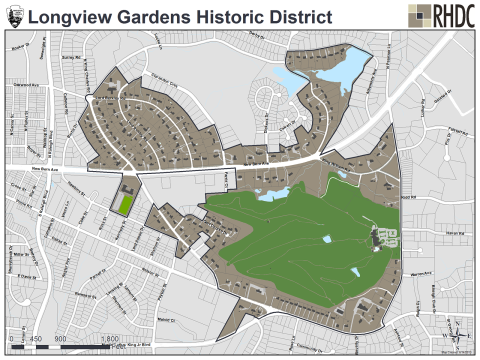
This National Register district map is provided for illustrative purposes only and does not represent the official zoning map, which is maintained in iMaps.
Physical Description
Longview Gardens is Raleigh’s largest mid-20th century custom residential subdivision and features the work of several notable architects and landscape architects. Located 1-½ miles east of downtown, it developed over a series of three phases: 1938-1940, 1948, and 1959. Its architectural styles reflect this progression, with the earlier homes embracing the Colonial and Tudor Revival styles, followed by the popular post-war Ranch and Split-Level styles.
The district’s revival houses are mostly two-story brick, stone, or weatherboard and share common features: pilastered entrances, modillion cornices, and large windows with panel aprons. A handful of the homes were architect-designed. Between 1941 and 1943, James Salter designed the weatherboard Colonial Revival Eure House and his own French Eclectic residence on N. King Charles Road, while William H. Deitrick designed the brick Colonial Revival Mason House. One-and-a-half-story Period Cottages with revival details were also popular during this period.
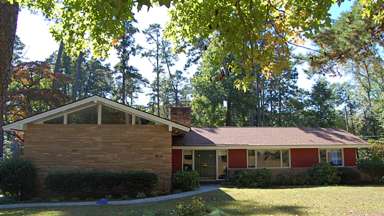
After World War II, cottages gave way to the Ranch style, which came to make up two-thirds of the district. Many were custom-built but possess the low, wide massing, side-gabled or hipped roofs, wide overhanging eaves, and interior chimneys characteristic of the style. Exterior stone veneer and picture windows are also prevalent. Architect Louis Polier designed his family’s brick and board-and-batten Raised Ranch house in 1956 and may have also been behind the brick and frame Contemporary Norwood Smith House and the brick Modernist Adams House.
Split-Level homes continued to bring Modernist detailing to the neighborhood. Tom Cooper designed his family’s house on King William Road about 1951 and is likely responsible for the similarly designed Dixon House next door. These low-set stone and frame houses have ribbons of casement windows reminiscent of Frank Lloyd Wright’s Usonian homes. Leif Valand designed a Modernist brick-and-frame home in 1957, and engineer John Castleberry designed his family’s residence on Peele Place, unique for its below-ground-level two-story wing that appears to be one-story.