
Jump To:
Designation Documents
Raleigh's main street has seen architectural flamboyance and shifting fortunes.
Period of Significance: 1874 – 1965
Properties with a contributing status in the district may be eligible for the federal and state historic tax credit programs. Visit the Historic Property Tax Credit webpage for more information.
History
The Fayetteville Street Historic District is important in the areas of commerce and architecture. From buildings influenced by the Picturesque mode of the 1870s, the Classical Revival skyscrapers of the early-20th century, to the group of four prominent bank buildings designed in the Modernist mode, the district contains the full range of architectural styles and types constructed in the commercial area of Raleigh from the period of rebuilding during Reconstruction after the Civil War to the mid-1960s when downtown attempted to remain viable in the face of the development of suburban shopping centers.
Since the 19th century, Fayetteville Street has functioned as the heart of the city. It has been the location of important events like the march of Union troops up the street toward the State Capitol in 1865, large parades to welcome home soldiers from this country’s wars, and as main commercial and banking center in downtown Raleigh. The physical evolution of Fayetteville and adjacent streets reflected national trends in both retailing and banking. That evolution has not, however, had the same result for those two industries. Many retail establishments first updated their store buildings and then, in the 1960s, vacated downtown in response to competition from suburban shopping centers and malls. Banks maintained their symbolic and increasingly impressive physical presence on and near Fayetteville Street.
The period of significance encompasses nearly a century of continued commercial, retail, and institutional development in central downtown Raleigh. The close of the period, 1965, reflects a discrete event, coinciding with the culmination of the mid-20th century emergence of the corporate bank building, a trend that dramatically changed the appearance of Fayetteville Street and the image of Raleigh as a government town. While mid-20th-century downtown banks were built in cities throughout the state, only Raleigh saw a concentration of four Modernist bank buildings at the same time in its central business district, all reflecting varying aspects of the architectural idiom and representing the city’s emergence as a banking center.
Historic District Map
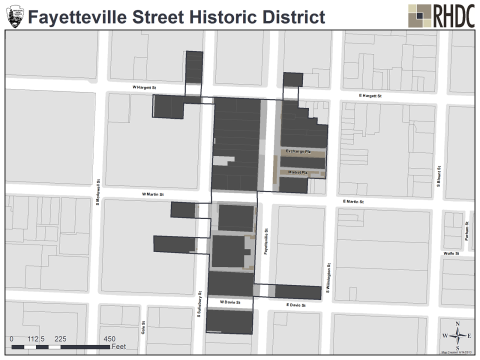
This National Register district map is provided for illustrative purposes only and does not represent the official zoning map, which is maintained in iMaps.
Physical Description
The oldest surviving buildings on Fayetteville Street reflect the ambition and success of Raleigh's businessmen in the years following the Civil War. Briggs Hardware, for instance, opened on Fayetteville Street immediately after the war. By 1874, Briggs replaced its first building with a towering four-story structure with cast-iron lion heads and an elaborate bracketed cornice of pressed sheet metal.
In the early 20th century, a proliferation of 2-4 story brick commercial buildings on Fayetteville and South Wilmington Streets housed Raleigh's white commercial center. In the 1920s, architectural competitiveness and a building boom contributed to the vertical growth of the city as showy skyscrapers clustered on and around Fayetteville Street. Architectural styles on the street include Italianate, Second Empire, Classical Revival, and Art Deco. A second skyscraper boom in the 1960s introduced Modernist towers into the skyline.
In the mid-20th century, retail establishments updated their store buildings at the ground floor in order to look current to shoppers, but the upper stories still show their 19th and early-20th-century pedigree. Trying to revitalize the area in the 1970s, the city converted the blocks just south of the Capitol into a pedestrian mall. By the 21st century, the city deemed the project a failure and removed the mall and restored vehicular traffic. Several of Fayetteville Street's neglected retail houses have been rehabilitated and put into use as offices and restaurants.