
Jump To:
Designation Documents
Founded in the mid-19th century to more humanely care for the state's mentally ill patients in a calm and naturalistic environment.
Period of Significance: 1856 – 1940
Properties with a contributing status in the district may be eligible for the federal and state historic tax credit programs. Visit the Historic Property Tax Credit webpage for more information.
History
Massachusetts reformer Dorothea Dix persuaded the North Carolina legislature to authorize a hospital for patients with mental illnesses, where they would be treated for their illnesses rather than simply locked up. The resulting 1848 legislation required a site with a cheerful view, copious sunshine, and good drainage, providing fresh air and enabling therapeutic farming and gardening. Dorothea Dix helped select the location, a hilltop southwest of Raleigh that had been Spring Hill, the plantation home of Theophilus Hunter. Hunter's house still stands.
Andrew Jackson Davis designed a commanding building, under construction from 1850 to 1856, and made even more impressive by its siting atop the hill. The building featured a center temple-front section topped with a circular belvedere and flanked by long wings housing men on one side and women on the other. Throughout the 20th century, the building was altered repeatedly, and the center section was eventually demolished to accommodate an updated hospital building in the 1950s. Other buildings surrounded Davis's original hospital, forming a self-contained campus in a naturalistic landscape. The campus included active farm fields and pastureland, housing for staff, a small school, and special-use buildings including a chapel and gymnasium.
Historic District Map
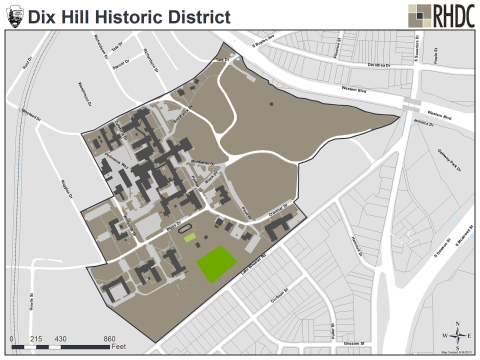
This National Register district map is provided for illustrative purposes only and does not represent the official zoning map, which is maintained in iMaps.
Physical Description
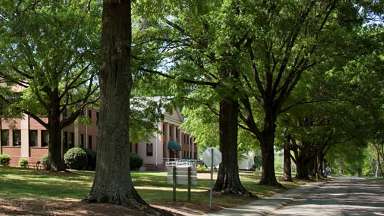
Dix Hill has statewide historical significance for its early and continued role in providing humane treatment for North Carolinians suffering from mental illnesses. The much-altered original hospital stands at the top of Dix Hill; the north slope of the hill, known as the Grove, is populated with mature Oak and Dogwood trees. The Grove's naturalistic landscape and the siting of the hospital on a hill with such remarkable vistas reflect the treatment ideology behind the hospital's founding: that the provision of clean air, advantageous views, and plenty of sunshine could help restore patients to good health. The evolution of the campus and landscape at Dix Hill reflects the changing treatment philosophies practiced there, including the self-contained nature of the hospital in the early and mid-20th century.
What was once a rural spot is now a prime downtown location. Much of the land became North Carolina State University's Centennial Campus in the late 20th century; another parcel is home to the State Farmers' Market. The State of North Carolina's Department of Health and Human Services is slated to move off the site as the City of Raleigh redevelops the existing Dix Hospital facilities and campus for use as a new regional park.