
Jump To:
Designation Documents
The Depot District received and redistributed a daily average of seventy-eight rail cars packed with goods in 1929.
Period of Significance: 1880 – 1960
Properties with a contributing status in the district may be eligible for the federal and state historic tax credit programs. Visit the Historic Property Tax Credit webpage for more information.
History
The railroad came to Raleigh in 1854, bypassing downtown but cutting through the southeast quarter of the city. A frame depot at West Cabarrus and South Harrington Streets served the city for a few decades. The depot did not survive, nor did the residential neighborhood that surrounded it and nearby Nash Square.
Raleigh's location made it a wholesale distribution hub in the 1910s and 1920s. By then, three rail lines and a major highway passed through Raleigh, connecting New York with Florida. Warehouses, depots, and hotels replaced 19th-century dwellings and housed the transportation-related activities centered on Raleigh's 1890 Romanesque Revival-style Union Station at 224 South Dawson Street. Delivered by rail, goods came from producers and distributors who filled warehouses with everything from food to building materials to barber supplies. Goods were shipped out again by rail or truck to local markets. The Southern Railway built a separate freight depot at 327 West Davie Street in 1912.
Nearby hotels and restaurants stayed busy with travelers and salesmen. The only surviving hotel is the slender three-story building at 217 West Martin Street, built in 1920. In 2022, the Raleigh City Council rezoned this former long-time home of the Berkeley Café music venue to allow for increased density.
Factories began locating in the emerging industrial quarter of the small state capital. Allen Forge & Welding Company built a blacksmith shop in the 1910s at 409 West Martin Street. In 1925, Allen built a larger shop at 417 South Dawson Street, and Brogden Produce bought and enlarged the original shop. The ca. 1916 Dunn Bros. The building at 311-313 West Martin Street housed a wholesale grocery and merchandise brokerage firm.
In 1949, with rail traffic showing no signs of slowing down, the Southern Railway built a Colonial Revival passenger depot at 320 West Cabarrus Street. Pete & Mike's Grill followed, at the corner of South Dawson and West Cabarrus Streets. Before the end of the 1950s, the trucking industry began to dominate rail shipping, lessening the importance of the rail-related buildings in the Depot District.
Historic District Map
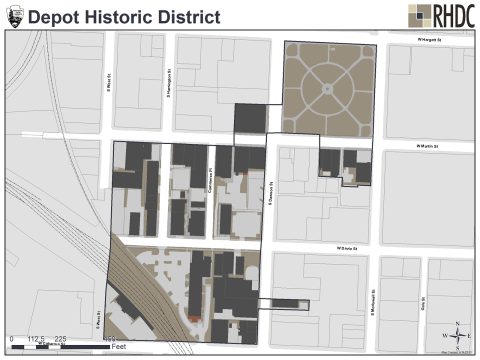
This National Register district map is provided for illustrative purposes only and does not represent the official zoning map, which is maintained in iMaps.
Physical Description
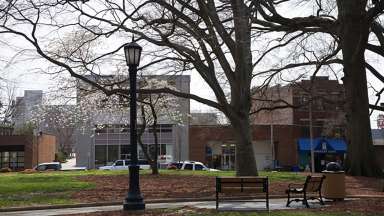
The Depot District contains the city's only significant collection of buildings related to the heyday of railroad transportation and shipping in Raleigh. The buildings include freight and passenger depots, warehouses, factories, hotels, cafes, and shops dating from the 1880s through the 1950s. The district also includes Nash Square, one of the two remaining park squares dictated by the first plan of the city, drawn in 1792. Despite the plan, Nash Square was home to a military campground and plant nursery before finally becoming a formal park in the early 20th century. A Works Progress Administration (WPA) era redesign altered the early Beaux Arts plan, which features a formal, symmetrical landscape. The new design added curvilinear planting beds, improved drainage, provided concrete benches, and resurfaced paths.
While the railroad declined in importance in the middle of the 20th century, the Depot District emerged in the early 21st century as an arts and entertainment district. Fine art galleries, restaurants, and nightclubs have moved into the spacious warehouse, factory, and depot buildings that remain from Raleigh's industrial past.