
Jump To:
Designation Documents
One of Raleigh’s best-preserved speculative post-WWII subdivisions (developed with racially restrictive covenants).
Period of Significance: 1947 – 1949
Properties with a contributing status in the district may be eligible for the federal and state historic tax credit programs. Visit the Historic Property Tax Credit webpage for more information.
History
Platted in 1946, the Capitol Heights subdivision developed as a result of the postwar housing demand. The land belonged to Raymond D. Kelly, owner of the Interstate Fruit Exchange, and G.B. Wynne, and may have originally been a pecan farm. George Henry Wright and Ernest I. Clancy were the primary builders of the Capitol Heights neighborhood. By 1948, Wright had overseen the construction of the majority of Capitol Heights’ homes, at which point he began to sell his undeveloped lots to the Clancy Construction Company and the Curtis Construction Company.
The suburban development boom, as expressed in Capitol Heights, was fueled in part by government agencies like the Federal Housing Administration (FHA) and the Veterans Administration (VA), which provided affordable financing to returning vets and their families. Developers, eager to profit from the programs, followed agency regulations to ensure their homes would qualify. This often resulted in homogenous suburban neighborhoods, as evidenced by Capitol Heights. Additionally, developers placed their own covenants on their neighborhoods. In August of 1946, Kelly and Wynne restricted the lot size and setbacks, buildings, and racial composition of Capitol Heights. A one-story house was to be no less than 750 square feet and cost a minimum of $4000.
Because of its development under the framework of the FHA and VA programs, and due to its high level of integrity, today the Capitol Heights neighborhood represents one of the best-preserved post-war speculative subdivisions in Raleigh.
Historic District Map
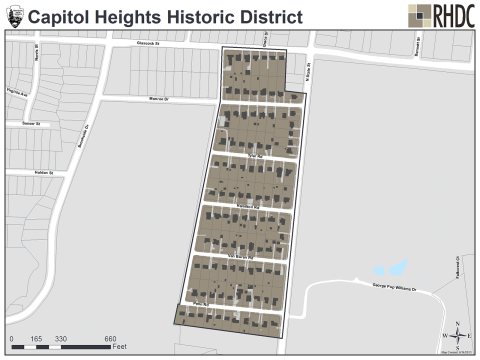
This National Register district map is provided for illustrative purposes only and does not represent the official zoning map, which is maintained in iMaps.
Physical Description
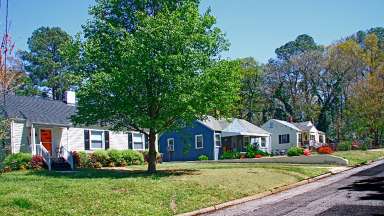
Capitol Heights is a post-World War II neighborhood 1½ miles northeast of downtown Raleigh. Developed between 1947 and 1949, the six-block district is generally made up of one-story, two- and three-bedroom houses in the Minimal Traditional style. Lots are consistently sized, and houses are setback from the street. Side driveways are prevalent, and some homes have small garages or sheds in the rear.
Capitol Heights was constructed quickly by a limited number of builders; as a result, its homes are similar in design. Side-gabled roofs and brick or concrete block foundations are prevalent. Exterior materials include asbestos siding, brick veneer, and wood shingles, although replacement vinyl and aluminum siding is common. Two groups of homes in particular are especially reflective of their builders: those on the south side of Taylor Road, built by the Curtis Construction Company, and those on the east end of Penn Road, erected by the Clancy Construction Company.
The homes erected by the Curtis Construction Company are exposed concrete block construction, with side-gabled roofs, metal casement or wood double-hung windows, and small gable- or shed-roofed porches. The Clancy Construction Company homes are frame construction with concrete block foundations. They have L-shaped plans with entrances near the intersection of the wings, with wide roof overhangs, wood or asbestos siding, and six-over-six double-hung windows or two-over-two horizontal-pane windows.