
Jump To:
Designation Documents
Two centuries of Raleigh's history are represented in the architecture of the Capitol Area Historic District.
Period of Significance: 1792 – 1950
Properties with a contributing status in the district may be eligible for the federal and state historic tax credit programs. Visit the Historic Property Tax Credit webpage for more information.
History
The Capitol Area Historic District embraces the oldest section of Raleigh. The city was established and laid out in 1792, and the original street plan remains from that period. The oldest surviving buildings also date from the end of the 18th century: Haywood Hall, a Georgian-Federal house begun in 1792 and the White-Holman House, a tripartite Federal house built around 1799. The 1813 State Bank of North Carolina that stands nearby is North Carolina's oldest surviving financial building.
The 1840 State Capitol and the 1854 Richard B. Haywood House are both Greek Revival structures, reflecting the popularity of that style in the mid-19th century. Christ Episcopal Church and First Baptist Church also date from the mid-19th century. Both are Gothic churches, but they differ substantially in appearance. Other churches in the district date from the early 20th century, including the Gothic-style First Baptist Church on South Wilmington Street, notable for its association with an African American congregation.
Aside from the Capitol, government buildings date from the late 19th century through the mid-20th century. These substantial buildings reflect the character of the Capitol with granite facades and Classical detailing. The 1888 Labor Building (originally the Supreme Court and State Library Building) is the oldest of the district's collection; the 1950 Highway Building is the newest. The remainder, dating from the early 20th century, illustrates the state's growth during that period.
A few properties document the historic preservation movement. The 1799 White-Holman House was relocated to its current site to prevent demolition. The city stopped using the 1887 Raleigh Water Tower by 1924, and Raleigh architect William Henley Deitrick rehabilitated the tower in the 1930s and made it his office. In 1963, Deitrick deeded the tower – with preservation covenants – to the state chapter of the American Institute of Architects (AIA). The tower is now under private ownership.
Historic District Map
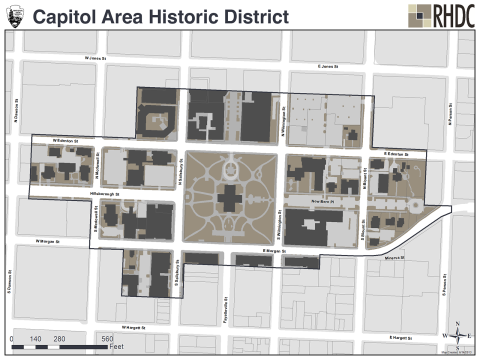
This National Register district map is provided for illustrative purposes only and does not represent the official zoning map, which is maintained in iMaps.
The Capitol Area Historic District is also designated as a local Historic Overlay District (HOD). HODs are a separate type of district from the National Register. HODs are zoning overlays designated by the Raleigh City Council. It has different rules, benefits, designation process, and sometimes boundaries.
Physical Description
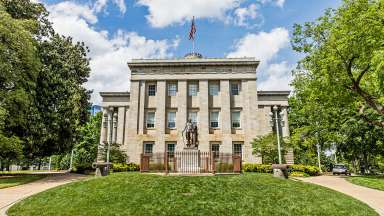
The most prominent building in the Capitol Area Historic District is the State Capitol, a Greek Revival granite building dating from 1840. However, the park square and surrounding street plan are actually much older than the building, dating from a 1792 plan drawn by surveyor and legislator William Christmas. His plan for Raleigh included a city of a single square mile, with Union Square at the center surrounded by four smaller park squares. Main streets at each compass point extend out from Union Square; those streets were Halifax, New Bern, Fayetteville, and Hillsborough Streets. New Bern and Hillsborough Streets, the two east-west streets in the plan, form the spine of the Capitol Area district. The State Capitol stands at the center of Union Square, surrounded by memorials and statues. Concrete walkways meander throughout the open space of the square.
Institutional buildings, primarily rendered in the Classical Revival style, dominate this district. Weighty government buildings, generally 2–3 stories tall, stand side-by-side with Romanesque or, more commonly, Gothic Revival church complexes. Houses dating from the late 18th century through the 20th century stand at the east end of the district.