
Jump To:
Designation Documents
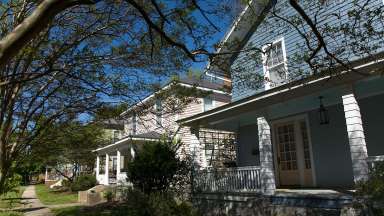
Craftsman bungalows dominate the curvilinear streetscapes of one of Raleigh's earliest planned suburban neighborhoods (including racially restrictive covenants).
Period of Significance: 1907 – 1930
Properties with a contributing status in the district may be eligible for the federal and state historic tax credit programs. Visit the Historic Property Tax Credit webpage for more information.
History
When real estate firms began developing old plantation lands just beyond the city limits in response to the early-20th-century housing shortage, the hundred-acre wooded portion of William Montford Boylan's estate offered a good location. It was just west of downtown, and the hilly terrain lent itself to a picturesque, curvilinear street plan. Parcels went on sale in 1907 and all were sold by 1915. A large parcel reserved from the sale provided space for a neighborhood park in the middle of the development.
Construction proceeded more slowly than the sale of land and continued through the late 1920s. In 1926, as Boylan Heights filled with family-friendly houses, a neighborhood school built in the park opened its doors. The neighborhood was the quintessential middle-class residential development of the early 20th century. Like many 20th-century planned subdivisions in Raleigh, the developers sold lots with racial covenants attached to exclude Black families from living in the neighborhood.
The architecturally conservative dwellings were in keeping with Raleigh's overall appearance in the early 20th century. The variety of house styles and sizes created a hierarchy of streets within the neighborhood, with Boylan Avenue being the finest in the development. The flanking Cutler and Kinsey Streets were secondary to Boylan Avenue. The neighborhood's extensive collection of modest bungalows populate the remaining streets in Boylan Heights, where smaller lots and shallower setbacks create a dense grid.
The Great Depression hit Boylan Heights hard. White-collar residents moved to newer suburbs in the 1930s, while many blue-collar residents lost their homes. Houses became rentals, and the larger dwellings were divided into apartments. This trend continued into the 1980s, when a renewed interest in urban living began to spur Boylan Heights’ slow conversion back to a neighborhood of predominantly owner-occupied dwellings. Many houses have been renovated to provide additional living space and have been updated to accommodate modern lifestyles.
Historic District Map
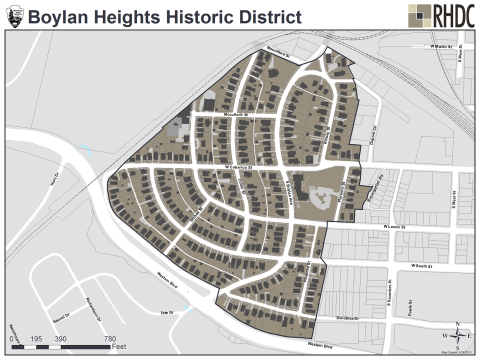
This National Register district map is provided for illustrative purposes only and does not represent the official zoning map, which is maintained in iMaps.
The Boylan Heights Historic District is also designated as a local Historic Overlay District (HOD). HODs are a separate type of district from the National Register. HODs are zoning overlays designated by the Raleigh City Council. It has different rules, benefits, designation process, and sometimes boundaries.
Physical Description
Boylan Heights is one of Raleigh's earliest planned suburbs, and its layout contributes heavily to the neighborhood's distinctive character. The curvilinear street plan wraps around the hills of the neighborhood while rear alleys bisect each block, providing hidden access to garages and service areas. Mature shade trees line the streets and front porches, and concrete sidewalks provide a pedestrian zone between the street and the residential interiors.
Architecturally, Boylan Avenue is the showpiece of Boylan Heights, and deed restrictions and covenants ensured that the neighborhood's largest dwellings would line the street. Required front yard setbacks are also deeper along Boylan Avenue than on other neighborhood streets, creating more expansive lawns to set off the large houses. Architectural styles found on the street include transitional Queen Anne/Colonial Revivals, Dutch Colonials, and Foursquares with Colonial Revival or Craftsman detailing.
Despite the varied housing stock on Boylan Avenue, the bungalow is the most dominant house type in the neighborhood. Bungalows, often rendered in the Craftsman style, fill the smaller parcels on the cross streets and the streets at the edges of the district.