
Jump To:
Designation Documents
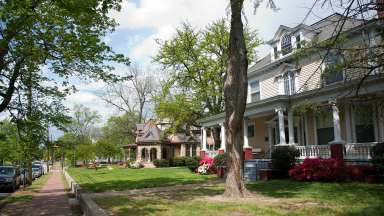
North Blount Street was Raleigh's most fashionable neighborhood between the Civil War and World War I.
Period of Significance: 1870 – 1920
Properties with a contributing status in the district may be eligible for the federal and state historic tax credit programs. Visit the Historic Property Tax Credit webpage for more information.
History
Just before the Civil War, this area was semi-rural, dotted with a few large villas and the developing campus of Peace Institute. Between 1860 and 1870, Raleigh's population grew by 63%. Residential development moved north from the intersection of North Blount and North Streets, and the pastoral area became more suburban in nature. The first substantial house built in Raleigh after the Civil War was the impressive Second Empire Heck-Andrews House at 309 North Blount Street. The house, which featured a three-story tower and a dramatic mansard roof, set the tone for construction on what quickly became a fashionable street with houses built by industrialists, railroad executives, and planters.
North Blount Street's reputation as Raleigh's finest neighborhood solidified in 1883 when the state decided to build the Executive Mansion on Blount Street. Prisoners from the state penitentiary built the house and sidewalks on the surrounding block using bricks they formed by hand. Some inscribed the bricks with their names. The mansion, under construction for several years, finally stood complete in 1891.
Residential building continued in the neighborhood, particularly after the turn of the century, through the 1920s. Newer suburban developments like Hayes Barton, Boylan Heights, and Cameron Park proved more popular, and construction in the Blount Street area slowed. Throughout the middle decades of the 20th century, original owners of some of the larger houses moved out or passed away, and new owners subdivided the dwellings into apartments. In 1969, the State Property Office began acquiring houses for use as state offices. The state also moved several houses on North Wilmington Street to North Blount Street to accommodate the new government mall under construction in the 1970s.
While the State continues to maintain offices in some of the district’s prominent buildings, others have been converted to private office use. More recently, the surrounding area has also been redeveloped with more multi-family units. A small north section of the district, adjacent to William Peace University, retains its residential nature and use.
Historic District Map
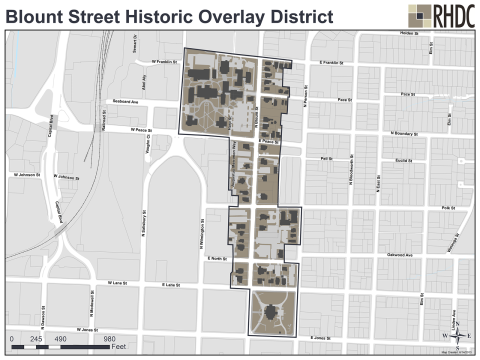
This district map is for illustrative purposes only and is not the official zoning map, which is maintained in iMaps.
*The Blount Street Historic District is technically not listed in the National Register of Historic Places (NRHP). However, the National Park Service (NPS) has certified this local Historic Overlay District as meeting National Register requirements for the purpose of using the historic rehabilitation tax credit programs.
The Blount Street Historic District is designated as a local Historic Overlay District (HOD). HODs are a separate type of district from the National Register. HODs are zoning overlays designated by the Raleigh City Council. It has different rules, benefits, designation process, and sometimes boundaries.
Physical Description
Population growth after the Civil War prompted residential development along Blount Street and surrounding streets above the northern city limit, marked by North Street at the time. While some antebellum houses remain, like the 1855 Greek Revival Lewis-Smith House at 515 North Blount Street, the once-rural area emerged as the city's finest neighborhood around the 1880s.
Large and handsome dwellings reflect the variety of architectural styles popular in the Victorian period, including Queen Anne (the 1882 Hawkins-Hartness House at 310 North Blount Street), Second Empire (the 1870 Heck-Andrews House at 309 North Blount Street), and Italianate (the 1875 Merrimon-Wynne House at 500 North Blount Street). The 1891 Queen Anne-style Executive Mansion stands at the center of what had been one of the five park squares in Raleigh's original town plan. The block is bounded by North Blount, Jones, Person, and North Streets. Blount Street houses that stand north of Peace Street are from a slightly later period of development and tend toward the late Queen Anne or Colonial Revival styles. The smaller bungalow house type appears along that stretch. William Peace University, founded in 1858 as Peace Institute and known previously as Peace College, is also in the district.