
Jump To:
Designation Documents
Bloomsbury is one of five early-20th-century White neighborhoods that surround the Five Points intersection (due to racially restrictive covenants).
Period of Significance: 1914 – 1952
Properties with a contributing status in the district may be eligible for the federal and state historic tax credit programs. Visit the Historic Property Tax Credit webpage for more information.
History
When local developer James Pou Jr. platted the Bloomsbury neighborhood in 1914, he highlighted Bloomsbury's connection to the streetcar: "No lot over three minutes walk from the car line," boasted advertisements. In the late 1910s and even more so in the 1920s, middle- and upper-middle-class residents bought houses on Bloomsbury Circle, Alexander Road, White Oak Road, Fairview Road, and Glenwood Avenue. Residents worked as life insurance agents, meat cutters, doctors, railroad flagmen, and roofers. As early as the 1920s, however, the automobile became more affordable, and Bloomsbury residents and buyers used autos as well as the streetcar to get downtown from their suburban houses. Detached garages proliferated, and the streetcar was gone by the mid-1930s.
Housing construction in Bloomsbury slowed to a trickle in the 1930s, thanks to the Great Depression, but much of the neighborhood had already been built out by then. In the several years following World War II, houses finally went up on the last empty stretches in the northeast corner of the development. The modest dwellings built in Bloomsbury after World War II reflect the country's emergence from a shortage of materials and a desperate need for housing: these houses are simple versions of the elaborate period revivals of the 1920s.
Like many in-town neighborhoods, Bloomsbury was briefly unpopular in the 1970s, but before the turn of the 21st century, the neighborhood regained its vitality. Many houses have been updated and expanded.
Historic District Map
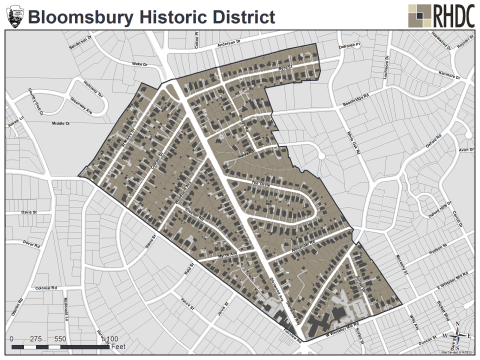
This National Register district map is for illustrative purposes only and is not the official zoning map, which is maintained in iMaps.
Physical Description
Bloomsbury is one of five early-20th-century neighborhoods that surround the Five Points intersection of Glenwood Avenue, Fairview Road, and Whitaker Mill Road. Bloomsbury lies northwest of the intersection, north of Glenwood Avenue as it heads away from Five Points towards Crabtree.
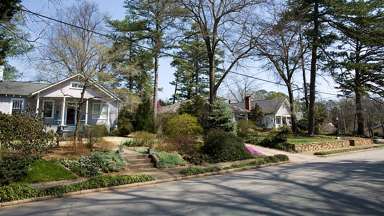
Early on, Bloomsbury attracted a mix of middle- and upper-middle-class white people. The earliest houses in Bloomsbury display a transition from the Queen Anne style that had been popular since the 1880s to a simplified Craftsman style that would dominate into the 1920s. The house at 1819 White Oak Road is an example, featuring the older-style two-story gable-front house with double-tier porch combined with the wide eaves and shingled siding typical of Craftsman style. As construction got into full swing in the 1920s, the bungalow house type dominated. Most Bloomsbury bungalows sport simple Craftsman elements like deep bracketed eaves and sheltering front porches. There is a great variety among the bungalows. Some are substantial versions with large half-stories under a gable roof and porte-cocheres extending to one side from the porch. Other houses feature a simplified version of the Colonial Revival style that was popular in the large houses of nearby Hayes Barton. Where the Hayes Barton houses were commodious brick versions with Georgian fanlights over imposing front doors, Bloomsbury's Colonial Revivals tended to be modest two-story frame houses, or even bungalows with Colonial Revival entry porches.