
Jump To:
Before Submitting an Application
Before you apply:
- Confirm the property's zoning and determine whether the proposed operation is short-term or long-term.
- Confirm that the proposed location meets applicable setbacks, spacing, parking, and operating requirements.
- Obtain required county and state food-service permits.
- Submit any required site plans, owner authorization, registrations, insurance, or other supporting documents.
- Do not begin operating until all required approvals have been issued.
Are there any prerequisites to the process?
Food truck vendors are required to obtain a Food Truck Permit for Vendors prior to operation on private property.
Any private property owner that wants to allow a food truck to operate on their property must obtain a Mobile Retail Application and Checklist.
Food Trucks in the public right-of-way
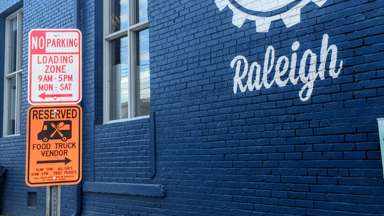
The City Council has identified five areas of the City as appropriate for limited food truck services located within the right-of-way. The City will clearly designate the permitted parking spaces dedicated to the operational area for food trucks. These areas are identified as follows:
- 0—199 blocks of South State Street between New Bern Avenue and West Hargett Street.
- 0—199 Blocks of Polk Street between North Wilmington Avenue and North Blount Street.
- 400 Block of West North Street between Harrington and North West Street.
- Blocks bounded by West Hargett Street, South West Street, West Davie Street and South Dawson Street.
Exceptions to the process
- Food trucks may conduct sales while parked on a public street when the City Council has approved a temporary street closing for a City-sponsored or neighborhood event such as a street festival/fair.
- Food trucks may operate on private property for a maximum of 20 days, three individual weekend events, or both each calendar year when utilizing a temporary event permit.
Public Right-of-Way Requirements
A Streetside Vending zoning permit is required if a food truck serves customers from the right-of-way in any of the four permitted parking spaces identified by the City.
Food trucks operating in these locations must:
- Maintain at least 5 feet of unobstructed pedestrian space on sidewalks and pedestrian paths, or more if required by applicable accessibility laws.
- Remain at least 100 feet from the main entrance of a restaurant, outdoor seating area, or competing permitted pushcart business.
- Remain at least 5 feet from driveways, utility boxes or vaults, accessible ramps, and emergency call boxes.
- Remain at least 15 feet from fire hydrants.
- Keep access to private property clear.
- Remove and properly dispose of all waste generated by the operation.
- Keep grease and liquid waste out of storm drains, tree pits, sidewalks, streets, and other public areas.
- Provide hand sanitizer for customers.
- Keep all equipment within or on the food truck.
- Not use tables, chairs, freestanding signs, or amplified sound in the public right-of-way.
If the food truck is intended to operate in any of the five areas of the City for limited food truck services within the right-of-way, the following additional items are required:
- Certificate of Insurance through an insurance carrier authorized or eligible to do business in the state of North Carolina for any damage to the public right-of-way and for any damages which the City might incur liability because of property damage or personal injury arising from the use of the public right-of-way. The minimum liability limit of the policy shall be $1,000,000.00. The City of Raleigh shall be listed as an additional insured as its interests may appear on all Certificates of Insurance. The Certificate Holder must read as follows: City of Raleigh, PO Box 590, Raleigh, NC 27602.
- The vendor shall hold the City, its officers, councilors, and employees harmless and indemnify them for any loss, liability, damage, and costs/expenses associated with its operations by executing an Indemnity Agreement.
- The Indemnity Agreement can only be entered into by the named insured on the certificate of insurance and named applicant on the permit application.
- Be sure that all of the information is correct on the Indemnity Agreement, otherwise, the City Attorney will not accept it.
- Do not leave the first line blank - it must state what the encroachment is, such as food truck street vending, outdoor seating, etc.
- The "Undersigned" must only state the name of the business listed with N.C. Secretary of State. Do not abbreviate this - it must be listed EXACTLY as it is recorded.
- Be sure to list the type of business, such as Sole Proprietor, Corporation, LLC, etc.
The printed name and title must be shown AND must be signed by the sole proprietor, a president or vice president of the corporation, the manager or managing member of the LLC, or the general partner of the partnership. Please verify the individual's name and title on N.C. Secretary of State's website first. - Be sure the document is signed and dated by a witness that knows their signature and authority to enter into the Agreement and provide the complete address including city, state, and ZIP code.
Submittal Instructions
Submit a Mobile Retail Application packet via the Permit and Development Portal.
What are the keys to success?
- Complete submittal package to include required documentation.
- Provide copies of required documentation (copy service is not available).
Paying Fees
A Plan Review Fee is due prior to project review. All other permit fees are due when permits are ready for issuance.
The Development Fee Guide provides a detailed list of specific development fees.
- It is recommended that fees be paid via the Permit Portal.
- All major credit cards and eCheck payments are accepted.
- If you have questions, please contact the Customer Service Center.
A fee calculator may be used to obtain an estimate of some building and trade permit fees.