
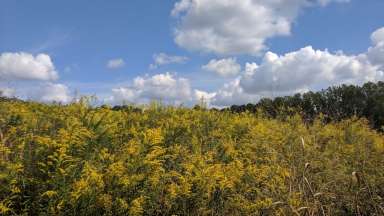
Fields of goldenrod usually appear at the same time that ragweed pollen is in the air. But it’s not these yellow flowers that make you sneeze!
There are many species of goldenrod, but they are known for their small golden-yellow flowers. The plants often grow in bunches, sometimes creating fields of tall yellow flowers. These flowers are bright and showy to attract hundreds of species of pollinating insects to feed on the nectar inside each flower and to take pollen to other flowers. Goldenrod pollen is so sticky and heavy that it relies entirely on pollinators to visit their flowers to move the pollen. This pollen is too heavy to become airborne and therefore does not have a chance to float around or make you sneezy.
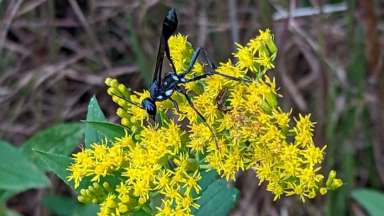
There are different species of goldenrod, but all have yellow, nectar-filled flowers that attract a variety of beneficial pollinators.
Ragweed on the other hand has less showy flowers, and does not even contain nectar to attract pollinators. The pollen grains of ragweed are small and wind-dependent. These small pollen grains become airborne to travel to other flowers and therefore may be the plant that is making you sneezy.
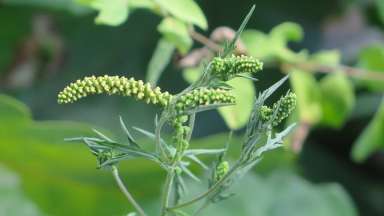
Ragweed doesn’t have nectar or showy flowers to attract pollinators. It depends on wind to carry pollen to other flowers.
However, since both flower at the same time, some look outside and blame the yellow flowers. That’s not to say that ragweed is unimportant. Even though it’s not a food source for pollinators who are looking for nectar, ragweed seeds and foliage are an important source of food for many animals. Ragweed seeds are oil- and fat- rich that last into the winter to sustain many species of birds such as sparrows and goldfinches. The leaves are eaten by a variety of plant-eating mammals. The leaves provide an important food source for caterpillars and beetles, which also helps to provide protein for insect-eating songbirds with growing chicks in the nest.
Next time you see a flowering goldenrod, look closely to see how many pollinators might be on it- and rest assured that getting closer shouldn’t make you sneeze.
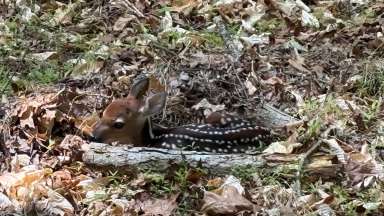
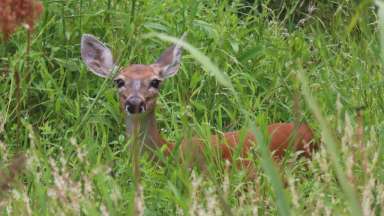
This fawn is not abandoned. It was left here by its mother who remains nearby.
Fawns are born with spots, which can help them camouflage in the forest leaves and grasses. Deer mothers may leave their fawns alone in leafy hiding places for up to 12 hours, while the mothers feed. Although a fawn can walk, the fawn’s instinct is to stay put. Fawns stay hidden and quiet because at this stage, the fawns are vulnerable to predation by larger animals such as coyotes, bobcats, and black bears.
In addition to needing time to feed, the mother’s instinct to stay away from their fawns for hours at a time helps prevent predators from easily finding their fawns. A mother deer will often move her fawn when she returns, even if only to a short distance away from the original hiding place, to help confuse predators.
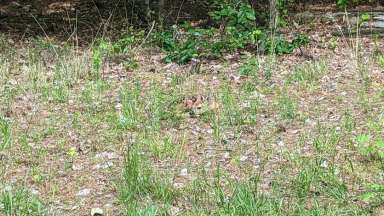
Can you find the fawn? This fawn was left more in the open than most hiding places.
If you see a fawn, the best thing to do is to leave it alone. It is a myth that a mother will not care for the fawn if a human touches it. However, for many other safety reasons it is best not to touch or move a fawn. Check back in 8-12 hours and see if the fawn has been moved by the mother - usually the mother will come for it when you are not present. Remember, as a prey animal, the mother might not trust humans, either! If you remain near the fawn you may be preventing the mother from approaching. Call a wildlife professional only if you know that a fawn has been left for well over 12 hours, if it’s clearly injured, or if it has been crying out for hours.
Fawns wean from their mother’s milk at about 10-12 weeks old. At this point you’ll see the still-spotted fawns grazing with the adults more often. They gradually lose their spots by about 4 months of age.
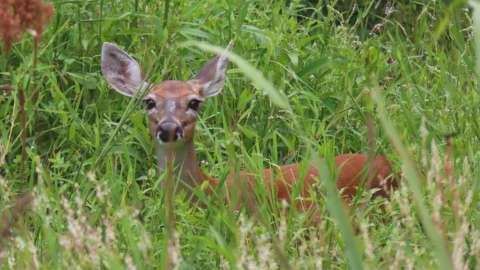
Adult deer will continue to hide rather than approach their fawns if humans are too close.
While it can be exciting to see a fawn, remember not to disturb it in its resting place. Take a photo from a distance, make sure pets are kept out of the area, and check back for it later. While young fawns may appear to be abandoned, they’re actually exactly where they are supposed to be.
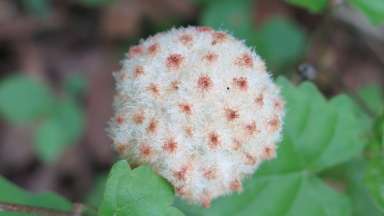
This puff ball is actually a gall created by a wasp.
While many galls are small or otherwise overlooked, there is one larger showy gall you might see in April -- the gall from the Wool Sower Wasp (Callirhytis seminator). The Wool Sower Wasp is a tiny non-stinging wasp about 1/8th of an inch long that is harmless to people. The female lays her eggs on young plant tissue, typically the stem or leaf, and the tree reacts to the larvae to create the gall. The Wool Sower Wasp gall looks like a large red and white puff ball. The larvae continue to develop within the gall as the gall provides protection and food source.
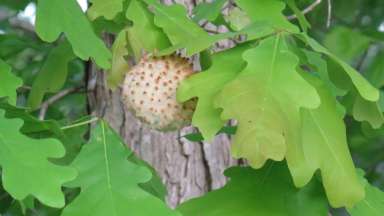
A Wool Sower Wasp gall on its typical host plant, a White Oak.
For this species of wasp, their eggs and resulting galls are almost exclusively found on White Oak (Quercus alba). However, it is rare for these galls to cause any significant harm or damage to their tree hosts. After the larvae emerge from the gall as adults, the remaining gall eventually withers away and falls off as if it was never there at all.