
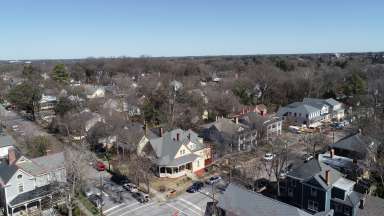
Zoning is the process of assigning a city or town into different areas, or “zones” used for different purposes (such as residential or business). These zones are used to keep the city organized, creating an orderly pattern of development. For example, zoning prevents a factory from being built in the middle of a neighborhood.
The City of Raleigh has a set of laws that determine how land can be used and what types of buildings can be built. If you want to know what can be built on a piece of land, the first step is to learn about the property’s zoning.
Below are some common terms often used when discussing zoning. View Raleigh's zoning services.
- Applicant: The person(s) applying to change the zoning of a property, known as rezoning. Anyone can apply to rezone land, if they complete all the following steps:
- Pay the application fee.
- Have a pre-application meeting with Planning and Development staff.
- Hold a neighborhood meeting.
- Built Environment: All physical, human-made surroundings that make up a city, such as buildings, parks, streets, utility poles, etc.
- Frontage: Additional laws that outline how a building should face or connect to the street. These rules effect how far back a building sits from the street, where parking goes, the amount and types of landscaping required, and other design requirements.
- Condition or Conditional Use (CU): Applicants can offer requirements, or “conditions” to their property to make the zoning requirements more restrictive. These rules must be enforceable by the City must be stricter than code.
- Density: The number of dwelling units (houses, apartments, townhouses) that can be built on a certain amount of land. This is usually written as number of dwelling units per acre.
- Intensity: How strongly a land use will impact the surrounding area(s).
Ex. Three story mixed-use building with apartments above and retail below is a more intense use than a single-family home.
- Rezoning: The process for changing the zoning on a piece of land and what it is allowed to be used for.
- Overlay District: This is an additional layer of zoning that adds, or “overlays,” specific rules to a piece of land designed to protect the character of a specific area of the city. While the zoning applies to large districts, overlays apply to areas such as historic districts, watersheds, or the airport to add specific rules that protect the special character of the area.
- Mixed-use Zoning (-X): The zoning code has multiple types of mixed-use zoning districts. These range from Residential Mixed-Use (RX), where a variety of homes and limited retail is permitted, to Industrial Mixed-Use (IX), where light manufacturing, retail, and limited housing is allowed. These districts always have a building height component. For example, an RX-3 district has a three-story height limit.
- Residential Zoning (R-): These zoning districts allows for different types of residential dwelling units at varying densities. They can range from low density, such as a Residential-4 (R-4) district that allows single-family homes up to four units per acre of land, to a moderate density such as Residential-10 (R-10) district, that allows up to ten units per acre of land.
- Zoning: The local law that regulates how property can be used: residential, commercial, industrial, etc. It also regulates building height and spacing, building type, how the building relates to the street, and other aspects of the built environment.
- Zoning District: The area in which a specific set of regulations apply.