
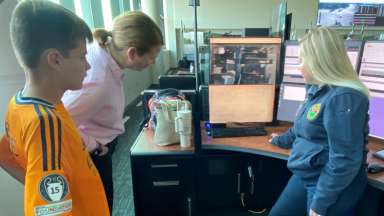
“I can’t believe I’m meeting the person whose life I helped save – and her husband, who did the work.”
Those were Call Taker Mariah Friedrich’s first words when she met Stephanie and Joe Schouten. Stephanie and Joe, along with their children Susan, 13, and Miles, 10, recently visited the Raleigh-Wake Emergency Communications Center about a year after Stephanie collapsed in cardiac arrest. Thanks to the CPR instructions Mariah shared over the phone with Joe, Stephanie survived and has since made a full recovery.
The single most effective way to improve the chances of surviving a cardiac arrest outside of a hospital, experts say, is to train 911 call takers to give CPR instructions over the phone.
That’s exactly what Mariah did when she answered Joe’s call. After asking some crucial questions, she determined that Stephanie was likely having a heart attack. CPR would need to be started immediately. Every minute delay in performing CPR on people in cardiac arrest decreases their chances of survival as much as 10 percent, according to the American Heart Association.
“I can’t remember the call very clearly, but I remember the call taker asking me questions and then calmly telling me what to do,” Joe says.
"She instructed me what to do and kept me calm and focused’
Stephanie had been feeling unwell that Saturday morning and the couple was getting into their car to drive to the emergency room. Joe went back inside to get a sweater for Stephanie. When he came back a few minutes later, he found Stephanie unconscious on the passenger seat.
“I immediately called 911, but I was extremely distraught,” he says. “However, the call taker was great. She instructed me what to do and managed to keep me calm and focused.”
Joe got Stephanie onto the garage floor and started chest compressions.
“I did it for about five or six minutes, but it felt like years.”
911 dispatched the call to the nearest fire station. After arriving on scene, firefighters, who complete an EMT course as part of their training, took over.
The chances of surviving a cardiac arrest outside of a hospital average about 1 in 10, according to the nonprofit Cardiac Arrest Registry to Enhance Survival. The registry collects data from 911 dispatch centers, EMS agencies and hospitals across the country.
At the hospital, a defibrillator was placed to prevent future arrhythmias.
With treatment and medication, Stephanie made a full recovery. She doesn’t remember passing out in the car or much else from the first few days after the heart attack. But after recovering, she was sure of one thing: She wanted to meet the person who helped her husband save her life. And Mariah loved the idea.
“It’s very rare that I find out what happened to the people who called or to their families. It’s wonderful to meet Stephanie and her family,” Mariah said while hugging Stephanie.