
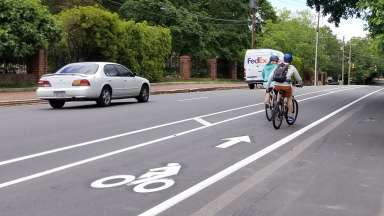
Two bikes traveling in the bike lane on Person Street near Governor's Manson, heading north

Current Bike lane on Person Street

Active Mobility Program

Improving active mobility and connectivity across Raleigh


Jump To:

 
Program Vision Where Can People Walk and Ride a Bicycle Today? How is the City of Raleigh Addressing Active Mobility Needs? Active Mobility Prioritization and Big Jump Map
The City of Raleigh’s Active Mobility Program develops sidewalk, bike, and other active mobility projects that enhance the city’s walkable and bikeable infrastructure. With a focus on increasing safety, connectivity, and access, the goal of the Active Mobility Program is to create a bike and pedestrian network where residents of all ages, abilities, and backgrounds can comfortably access nearby destinations, such as schools, parks, and transit stops throughout the city.

Program Vision

Create a connected, equitable and accessible network that makes walking, bicycling, and rolling safe, comfortable, and viable for all, fostering a healthier and more connected Raleigh. 

Where Can People Walk and Ride a Bicycle Today?

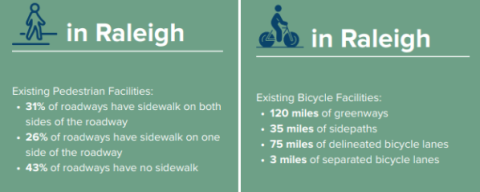
Existing Pedestrian ang Bike Facilities graphic

Existing Bicycle Infrastructure 


Existing Sidewalk Infrastructure 
How is the City of Raleigh Addressing Active Mobility Needs?

Active Mobility Plan
The Active Mobility Plan was adopted by City Council on November 18, 2025. The Active Mobility Plan updates the 2016 BikeRaleigh Plan and the 2013 Comprehensive Pedestrian Plan. Now complete, the Active Mobility Plan considers prioritization of projects, programs, and policies to make Raleigh a safer and more accessible place for pedestrians and cyclists.

The Big Jump
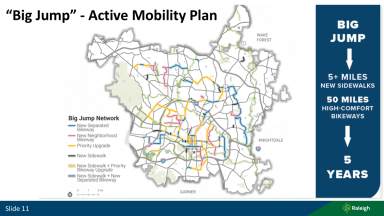
Within the Raleigh Active Mobility Network, the city has identified over 5 miles of sidewalk gaps and 50 miles of bikeways to be prioritized for implementation in the next five years. These projects create access to a complete sidewalk network, separated bicycle facilities, and neighborhood bikeways where current access may be only to incomplete sidewalks or bicycle lanes that lack separation. When completed, these projects will result in a Big Jump in the total mileage and overall connectivity of Raleigh’s active mobility network for pedestrians and cyclists. 

View the 2025 Active Mobility Plan.

Active Mobility Prioritization and Big Jump Map

This map was produced as part of the Active Mobility Plan.  It identifies and prioritizes future sidewalk and bike facility projects to improve conditions for people walking and biking.  

Priority sidewalk and bicycle projects fall into one of two categories: the short-term implementation projects, or “Big Jump”, and the long-term “Priority Network.” 
Active Mobility Prioritization Map

Big Jump Network - 5 Year Implementation
Within the Raleigh Active Mobility Network, the city has identified over 5 miles of sidewalk gaps and 50 miles of bikeways to be prioritized for implementation in the next 5 years. To align with the Plan goals for a safe, connected, and equitable network that can be implemented quickly, the Big Jump network projects were selected based on strategic criteria relating to connectivity and feasibility. 

The Big Jump provides connectivity to: 

  • Existing high comfort bikeways and greenways 
  • Neighborhoods across all City Council districts 
  • Schools, parks, and commercial districts. 

Big Jump projects were assessed for feasibility with consideration for existing curb space uses, pavement width, curb and gutter, and existing travel lanes. 

Prioritized Network – Beyond the Next 5 Years 
The priority network establishes a bold vision for pedestrian and bicycle connectivity and ensures that high-comfort pedestrian and bicycle facilities will continue to be incorporated on streets as the city grows. The Priority Network identifies the corridors that can realize this vision by examining: 
 

  • Context: the broader urban environment around these proposed projects. 
  • Access: the projects’ ability to create connections to active mobility corridors or nodes. 
  • Density: not necessarily of people or jobs, but of the places to which our community members are drawn. 
  • Equity: the degree to which a project invests in socially vulnerable populations. 

The sidewalk prioritization method helps us determine which sidewalk gaps to address first within the existing sidewalk network while the bike prioritization establishes priority corridors for a new, comprehensive bike network. 
 

  • A sidewalk project marked as high priority would likely be on a roadway with existing pedestrian safety concerns, have transit nearby, provide access to multiple community destinations, and serve a community that is more likely to be transportation disadvantaged.  
  • The priority bike network identifies corridors and connections that could have the most impact in terms of expanding access to destinations and serving vulnerable populations, while forming a cohesive network. 
Department:
Transportation
Service Categories:
Mobility Strategy and Infrastructure

Subscribe