
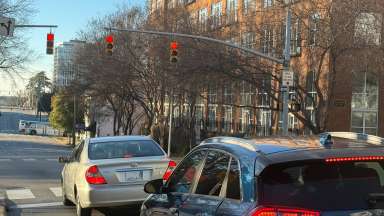
We’ve all been there. Nothing matches the frustration of sitting at a red light when no one is coming the other way.
City staff are working to change that. A pilot program is underway using AI to improve signal timing and safety.
“We believe leveraging technology will help us better understand and react to traffic issues,” says IT Manager Jim Alberque.
“We are turning real-time video from traffic cameras into data,” Alberque explains.
Jed Niffenegger, Transportation Manager, points out that traditionally this has been a manual and time-consuming process. Staff would stand at intersections with clipboards inputting traffic counts.
“In theory with this pilot project, we can have data at our fingertips to optimize traffic signals,” Niffenegger says. “We like to say, ‘real-time, all the time’.”
Pilot
The City has more than 200 traffic cameras throughout Raleigh.
During the pilot phase of the program, the AI system can analyze data from about a dozen cameras. The City doesn’t store the video or collect identifying information.
Potential
“If we can perfect and scale the pilot, we can provide our timing engineers with real-time accurate data so they can improve signal timing,” Niffenegger points out. “This can result in a monumental amount of cost savings in both time saved and fuel savings.”
For example, a corridor such as Capital Boulevard carries 60,000 vehicles per day. A 1-percent improvement in timing for a two-mile section with six signals could save tens of thousands of dollars per day.
Alberque and Niffenegger emphasize this could be very beneficial to a growing city like Raleigh. As traffic increases, the answer isn’t always to widen a road. Many corridors still have plenty of capacity.
Often, the problem with moving traffic is the intersections. This will help maximize what we have.
As the program and technology are fine-tuned, it will likely be used in other cities across the country.
As for that red light frustration? This AI technology could lead to less gridlock and safer intersections.