
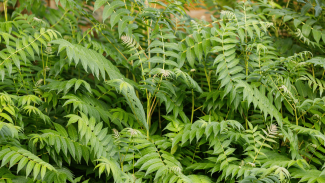
Tree of Heaven (Ailanthus altissima)
The spotted lanternfly (Lycorma delicatula) is an invasive insect that has been found in 19 states. The lanternfly feeds on the sap of many different plants and excretes a sticky fluid known as “honeydew” during feeding that can promote the growth of a damaging mold. The preferred host plant of the spotted lanternfly is the tree-of-heaven (Ailanthus altissima), a non-native invasive tree from Asia that can also pose a threat to native vegetation. However, lanternflies also feed on many commercial crops such as grapes, fruit trees, and hardwood trees used for lumber.
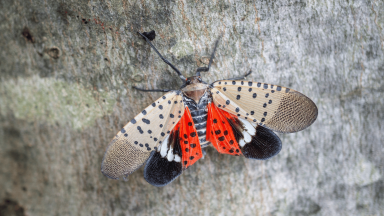
Adult spotted lanternflies are about an inch in length and are very colorful when their wings are spread. They have a black head, a yellow abdomen with black bands, and bright red hind wings with black spots. Their forewings are a pinkish-tan color with black spots and a distinctive black brick-like pattern on the tips. Adults will lay eggs on any outdoor surface between September and November, and when the egg masses dry, they resemble a smear of mud or concrete. The eggs hatch between April and May and remain in their juvenile form until late June.
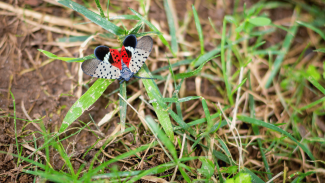
Spotted Lanternfly (Lycorma delicatula)
If you should find a spotted lanternfly, please report the sighting to the NC Dept. Of Agriculture Plant Industry and try to include a photograph if possible. You can also record your sighting using a smart phone app such as iNaturalist.
If a spotted lanternfly is found within a City of Raleigh Park, Nature Preserve, or Greenway, please contact the Raleigh Parks Invasive Species Program after you have reported the sighting to the NC Dept. Of Agriculture.