Jump To:
Syllabary
Aug. 2 - Oct. 25
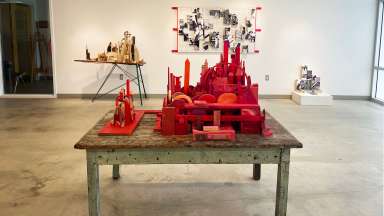
Syllabary is an evolving body of work by interdisciplinary Durham-based artist Jason Lord, emerging from questions he has returned to for years about the relationship between parts and wholes, the ways rules generate possibility rather than merely constrain it, the strange power of language to gather the world into names while inevitably leaving something outside them, and the different kinds of thinking that become possible through making. These questions are not illustrated by the work so much as discovered through the process of making it, emerging through assembling and disassembling, repeating and revising, working within self-imposed constraints, and allowing materials, forms, and images to migrate across different contexts. The objects in this exhibition are not expressions of ideas that existed beforehand. They are the material record of thought taking shape.
Exhibition and Reception Details
- Location: Pullen Arts Center, 105 Pullen Road
- Parking: Visitors must have a parking permit between 7 a.m. and 5 p.m., Monday through Friday. Check-in at Pullen Arts Center’s front desk for a license plate-based parking permit. View our parking map
- Cost: Free and open to the public
- Hours:
- Monday through Thursday, 9 a.m. to 10 p.m.
- Friday, closed
- Saturday and Sunday, 9 a.m. to 5 p.m.
- To purchase artwork, contact Pullen Arts Center for details.
Closing Reception
Join us at Pullen Arts Center on Saturday, Oct. 24, from 2:30 to 4 p.m. for a free closing reception. Check out the artwork, hear from the artist, and enjoy an afternoon of community at Pullen Arts Center.
About the Artist
Jason Lord is an interdisciplinary artist based in Durham, North Carolina. He works across sculpture, installation, drawing, photography, artist books, printmaking, assemblage, video, and sound, treating them as parts of a single, interconnected practice. His work investigates how ordinary objects reveal relationships between living systems, material histories, human ecologies, and built environment. Through installations, he reconfigures materials to examine how meaning emerges through relationships, attention, and time.
Lord received his MFA in Studio Art from the University of North Carolina at Greensboro and his BFA with Highest Honors from the University of North Carolina at Chapel Hill. His work has been exhibited throughout the Southeast and beyond. He is the recipient of the 2026 ArtFields Grand Prize and has been an artist-in-residence at the McColl Center, Vermont Studio Center, Hambidge Center, Penland School of Craft, the Peter Bullough Foundation, Virginia Center for the Creative Arts, Greensboro Project Space, and the Scrap Exchange.
More About the Exhibition
Syllabary is an evolving body of work emerging from questions I have returned to for years about the relationship between parts and wholes, the ways rules generate possibility rather than merely constrain it, the strange power of language to gather the world into names while inevitably leaving something outside them, and the different kinds of thinking that become possible through making. These questions are not illustrated by the work so much as discovered through the process of making it, emerging through assembling and disassembling, repeating and revising, working within self-imposed constraints, and allowing materials, forms, and images to migrate across different contexts. The objects in this exhibition are not expressions of ideas that existed beforehand. They are the material record of thought taking shape.
I have become less interested in finished objects than in forms that remain available to become something else without feeling incomplete in their present state. Built from a recurring vocabulary of materials, colors, structures, images, and forms that migrate across paintings, drawings, prints, sculptures, photographs, artist books, and temporary assemblages, the exhibition treats each work as one temporary configuration within a larger material vocabulary. The objects in this exhibition are neither as elemental as letters nor as conclusive as words. They are syllables: partially formed, endlessly recombinable, structured enough to generate meaning without determining it.
The gallery becomes a temporary world in which paintings, photographs, prints, drawings, shelves, pegboard, worktables, scrap wood, and printing blocks drift between identities or occupy several at once. Rather than resolving into fixed categories, they remain available to participate in new relationships, carrying traces of previous configurations while suggesting future ones. The recurring forms are less important as symbols than as opportunities to notice relationships unfolding across space and time. The exhibition resists finality in favor of forms that continue to become, unbecome, and recombine. If there is a hope running through this work, it is that we might become a little more comfortable with the provisional, finding in uncertainty not something to overcome but a condition that keeps attention, curiosity, and possibility alive.